
“Huge spaces, soaring ceilings, and imposing works of art put everyday life on pause. This space is its own world. One wanders from work to work, responding to their size and character-which often means walking around them or even inside them-while wondering in the back one’s mind, What is beyond? The works and the spaces they inhabit are of a size that impact one’s body as well as eyes, mind, and emotions.” I. Michael Danoff
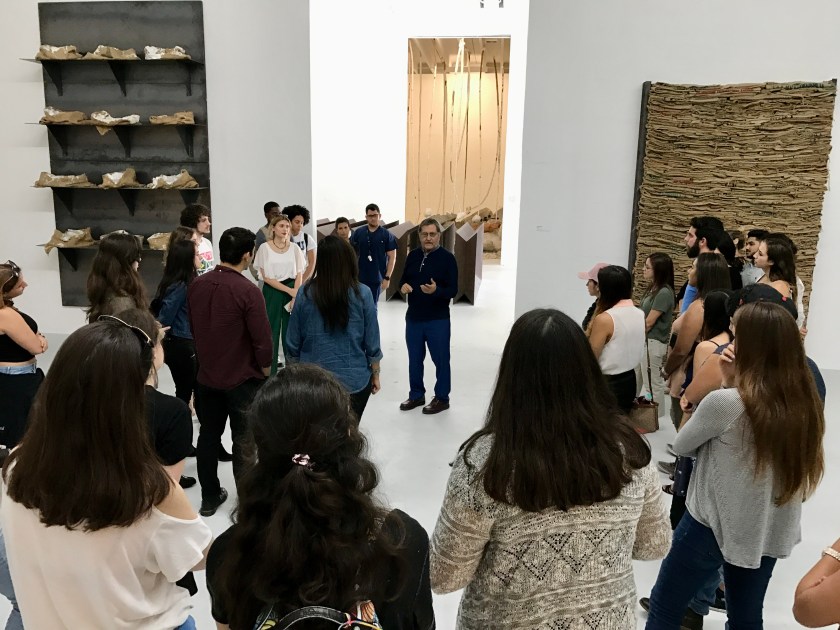
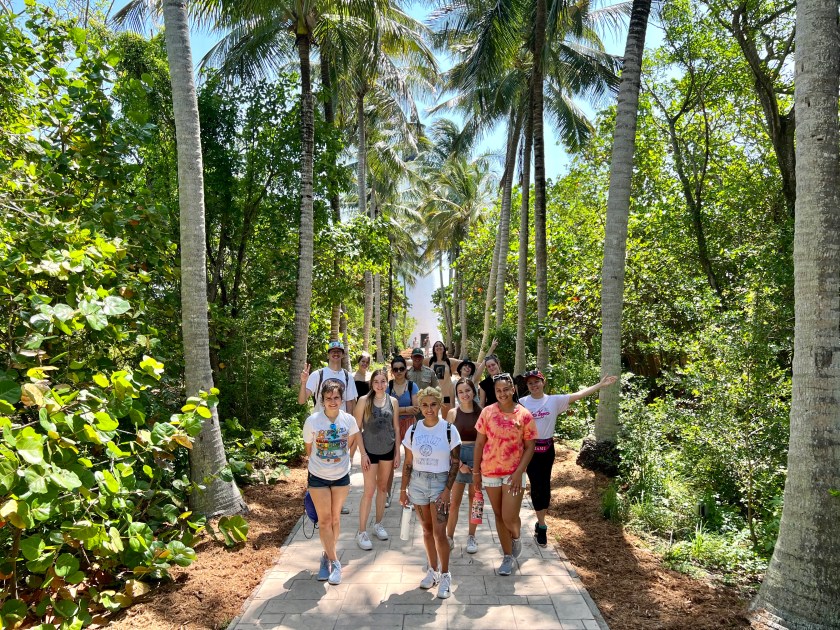
Since 2008, Mr. Margulies has personally welcomed over 1,000 FIU Honors College students to the Collection at the Warehouse.
Mr. Margulies is the chief benefactor to the Lotus House Women’s Shelter. “But Lotus Village’s chief benefactor, developer and art collector Martin Margulies, has just unveiled a new $19 million gift to the shelter project, bringing his total support to $44 million.” Andres Viglucci
THE MARGULIES COLLECTION AT THE WAREHOUSE
“The Margulies Collection at the Warehouse is a nonprofit institution located in a 50,000 square foot retro-fitted warehouse in the Wynwood Arts District of Miami. The Warehouse presents seasonal exhibitions from the collection of renowned collector Martin Z. Margulies as well as educational programs, special exhibitions and an international loan program. The Warehouse is operated and funded by the Martin Z. Margulies Foundation, a thirty-year resource for the study and enjoyment of the visual arts.”
https://www.margulieswarehouse.com/about
ACCESS
591 NW 27TH ST
Miami, FL 33127
Telephone: 305.576.1051
Email: mcollection@bellsouth.net
https://www.margulieswarehouse.com/
NOTE: Admission is free for Florida students with ID!
MISSION
“Our mission to serve the Miami community is fulfilled through educational programming such as lectures and regular tours with schools and museum groups given by Martin Margulies, longtime curator Katherine Hinds, and our team of dedicated associates. We place high importance on sharing the collection through gifts and generous loans to national and international museums and educational institutions.”
HISTORY
“In 1998, Martin Z. Margulies along with his longtime curator Katherine Hinds began looking for a suitable space to display the growing collection of photography, video and installation works, and sculpture of the Margulies Contemporary Art Collection. In 1999, the first phase of the Margulies Collection at the Warehouse opened to the public with an event to benefit the Lowe Museum at the University of Miami. After a series of expansions, the Warehouse now comprises 50,000 square feet of exhibition space with set hours each week. The Warehouse is open to the public October–April, during which time we welcome thousands of students and visitors from all over the world.” https://www.margulieswarehouse.com/about
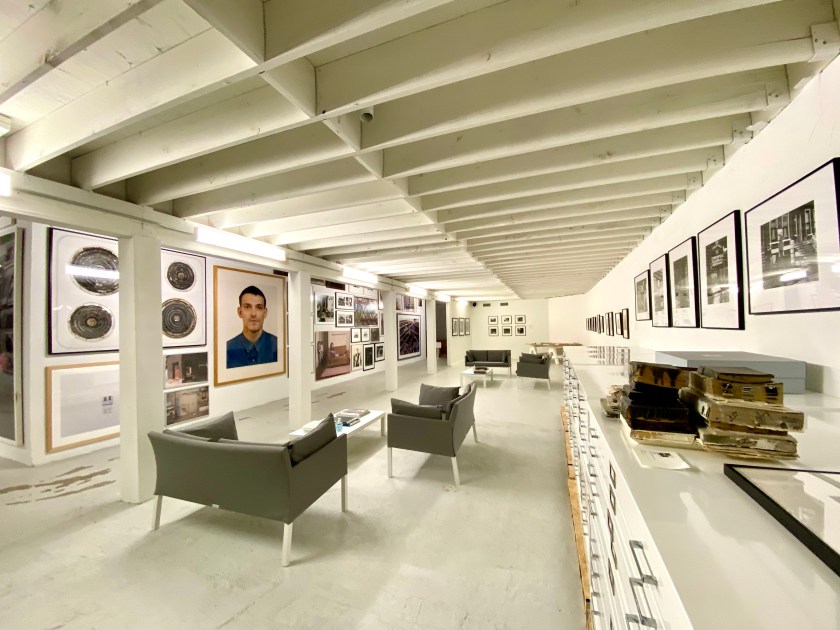
PHOTOGRAPHY STUDY CENTER
“The Photography Study Center at The Margulies Collection is a center for the education and research of contemporary and vintage photography with a mission to further visual literacy in our community. The Photography Study Center expands our commitment to photography by having a dedicated space that gives visitors, scholars, and students the opportunity for hands-on viewing of the photographs. The archives include flat-file style storage, exhibition space, and a reading center to provide an immersive experience with the photography collection. The Study Center produces annual exhibition programs and provides open access to its library, as well as offering appointments for scholarly review of the flat files and artist films. Additionally, designed to serve multiple functions, is an adjacent café-style area accommodates reservations for conferences, meetings and gatherings.” https://www.margulieswarehouse.com/exhibitions/photography-study-center-at-the-margulies-collection-at-the-warehouse
SELECTED WORKS FROM THE PERMANENT COLLECTION
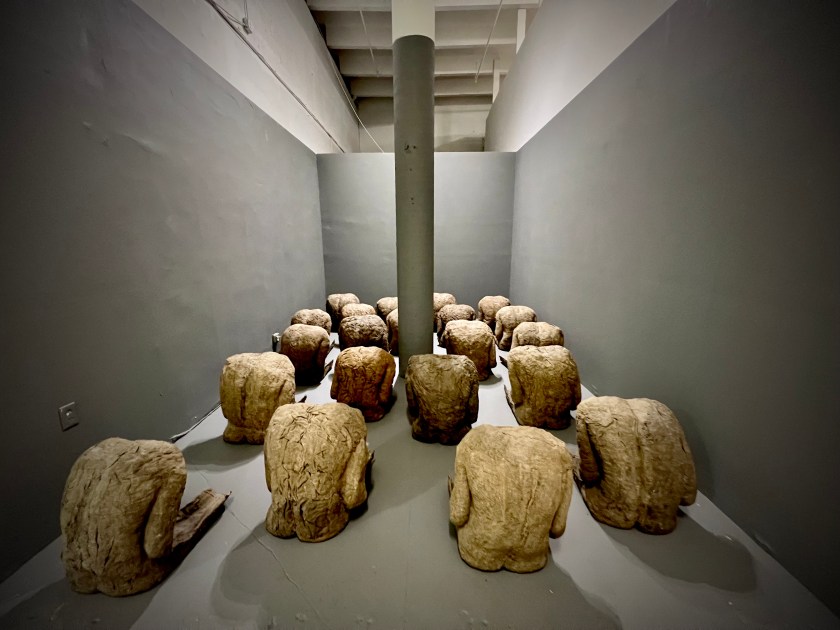
ABAKANOWICZ. 21 BACKS, 1982.
“When I investigate the human, I investigate myself. When I yield to my curiosity I do not expect rational explanations.” Magdalena Abakanowicz
“I have not really disturbed the original image I carry in myself. The man I deal with, in my work, is man in general. At the Venice Biennale, at ROSC in Dublin, in Paris and elsewhere, people who saw the Backs would ask: “Is it Auschwitz?””Is it a religious ceremony in Peru?” “Is it a dance from the Ramayana?” The answer to these questions is affirmative, because it speaks about the human condition in general.” Magdalena Abakanowicz
“During my Paris retrospective in 1982 a man standing in front of the 80 Backs said to me: ‘I understood: the face can lie, the body cannot.'” Magdalena Abakanowicz
“In 1984, curator Katherine Hinds and collector Martin Margulies presented a portfolio of sculpture in the collection to artist Magdalena Abakanowicz. The result of this meeting was that for the first time, the artist agreed to release a major work of burlap figures to an American private collection.” Margulies Collection
‘In the 1960s, the Polish artist Magdalena Abakanowicz received international acclaim for her large and imaginative abstract woven hangings made of various ropes and fibers. She began to make freestanding sculptures in the early 1970s from similar materials, particularly burlap, string, and cotton gauze. Her work since 1974 has featured fragmented human figures—faces without skulls, bodies without heads, and torsos without legs—placed singly or in large groupings. These body parts appear as hollow shells, the result of their being hardened fiber casts made from plaster molds. Yet despite their incompleteness, they are intended to be seen in the round, the hollow interior being as much a part of the piece as the molded exterior. The creases, ridges, and veins of the hardened-fiber surface assume organic characteristics, reminiscent of the earth’s rough surface or the cellular composition of human skin.” The Metropolitan Museum of Art
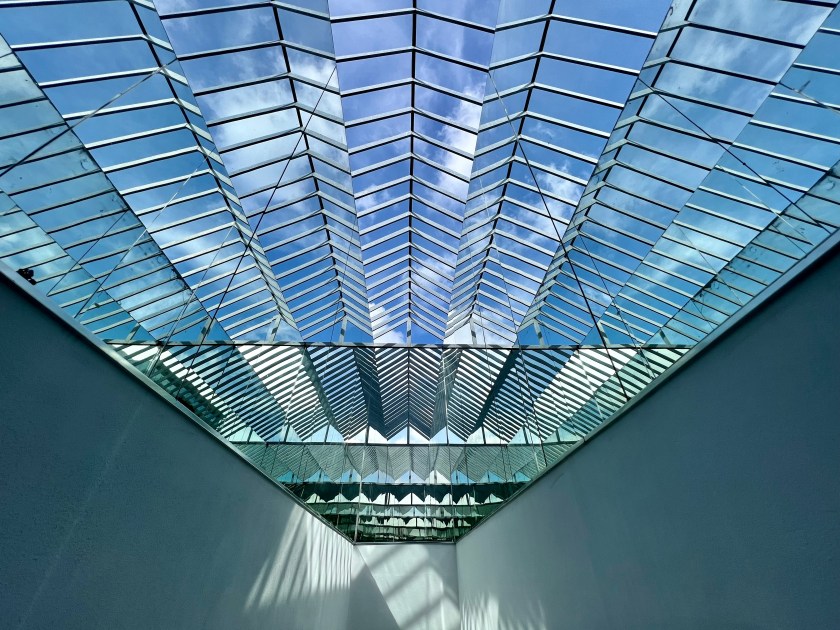
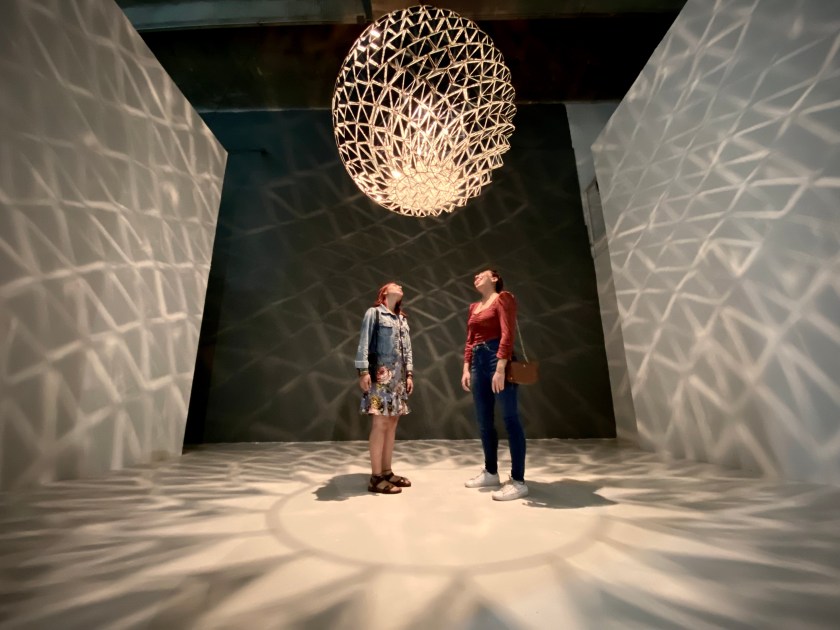
ELIASSON. YOUR NOW IS MY SURROUNDING, 2000.
“Eliasson uses simple natural elements—light, color, water, and movement—to alter viewers’ sensory perceptions. Predicated on the idea that ‘art does not end where the real world begins,’ Eliasson’s work lives in the active exchange between his creations and the viewers.” Art21
“One of the first major installations we showed at the Warehouse was Olafur Eliasson’s Your now is my surroundings (2000). I saw the installation at the Tanya Bonakdar Gallery, in Manhattan, and as I was leaving Tanya grabbed me and said, “Come back and look closely at this.” So I took a closer look. It was astonishing: a room with a raised floor had been specially built, and twelve-foot mirrors had been installed, generating an extraordinary effect. I realized that in order to accommodate the work, the gallery had to have a ceiling open to the sky above. We had just begun working on expanding our Warehouse in Miami by breaking through to an adjacent building, and in doing so we had discovered an abandoned alleyway. It occurred to me that we had the ideal site for this work. It has been almost seventeen years since the installation went on permanent view at the Warehouse, and thousands of young art students have seen it. Among all the art we have on view, this work renders the students speechless, as they see their reflections in the mirrors. This experience of “seeing themselves seeing” enables the students to talk and think about art in a new way, an outcome that is very gratifying for us.” Margulies Collection
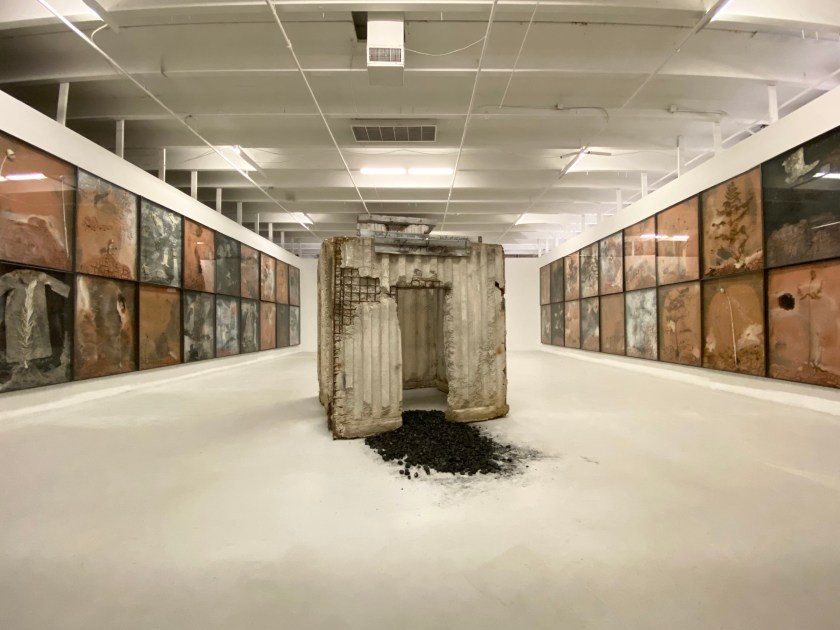
KIEFER. SECRET OF THE FERNS, 2007.
“One of the strongest installations in the Collection is Geheimnis der Farne (Secret of the Ferns) (2007), titled after Celan’s poem of the same name. Kiefer believes that ferns could tell us a great deal about our beginnings; like forests, they may contain secret knowledge. There are forty-eight paintings in this them have actual ferns as well as broken terracotta, which recall the rubble of the playgrounds of his childhood. The towers in the center refer to the Tower of Jericho and evoke Nazi structures in World War II concentration camps. Kiefer created these structures in his atelier using shipping containers as forms. Each one weighs 25,000 pounds. Needless to say, this was a difficult installation. Just getting the necessary machinery into the building was difficult. The total Kiefer layout up 16,000 square feet of space; it is the largest permanent presentation of Kiefer’s work in the United States.” Margulies Collection
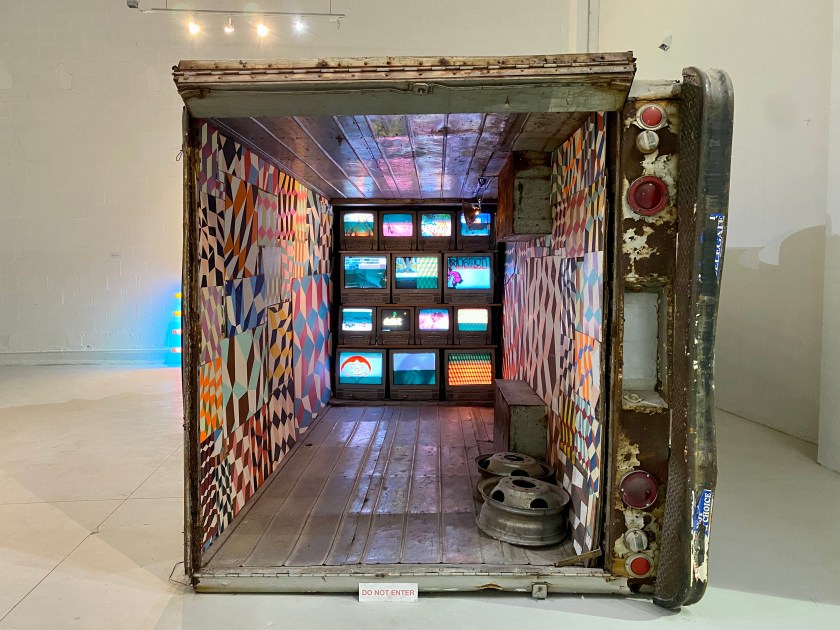
MCGEE. UNTITLED (TRUCK INSTALLATION WITH TVS), 2004.
“Barry McGee came out of the graffiti movement, which started in the early 1980s. The West Coast artist was among the notable few whose work was appropriated from its original urban setting to galleries and museums. The decontextualization of graffiti art which occurred when it was moved from the streets to institutions marked a point in United States history where counterculture became mainstream. Graffiti art has its roots in hip hop and urban culture and has served as a longtime platform for disenfranchised young creatives to have their messages seen and heard. Regarding his use of found objects, McGee compares his practice to curating and says “Someone’s probably made the most perfect thing I’m looking for if I look hard enough or close enough it’s already sitting out in the street or leaning up against something.” Margulies Collection
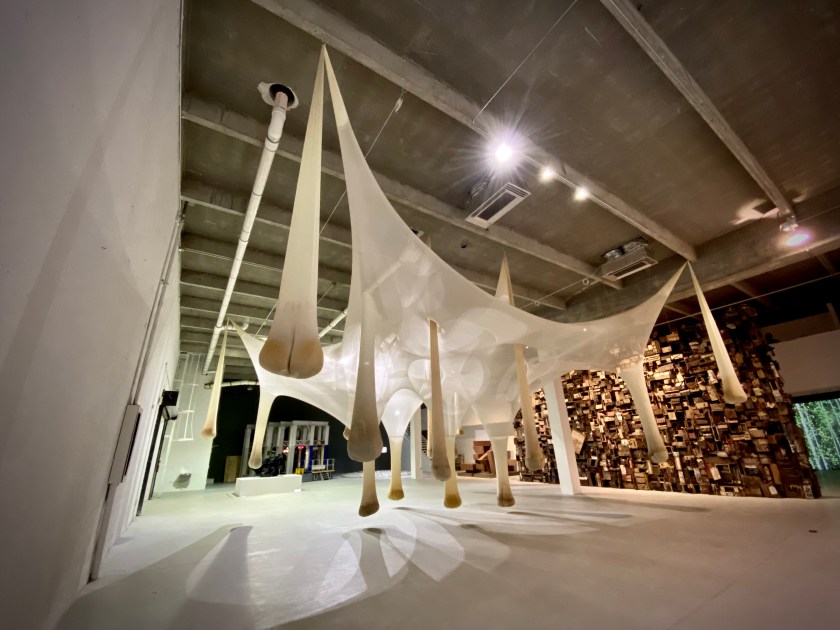
NETO. É Ô BICHO!, 2001.
Since the mid-1990s, Ernesto Neto has produced an influential body of work that explores constructions of social space and the natural world by inviting physical interaction and sensory experience. Drawing from Biomorphism and minimalist sculpture, along with Neo-concretism and other Brazilian vanguard movements of the 1960s & 70s, the artist both references and incorporates organic shapes and materials – spices, sand and shells among them—that engage all five senses, producing a new type of sensory perception that renegotiates boundaries between artwork and viewer, the organic and manmade, the natural, spiritual and social worlds.” Tanya Bonakdar Gallery
Neto’s sculpture is made of Lycra that contains the spices black pepper, clove, and turmeric.
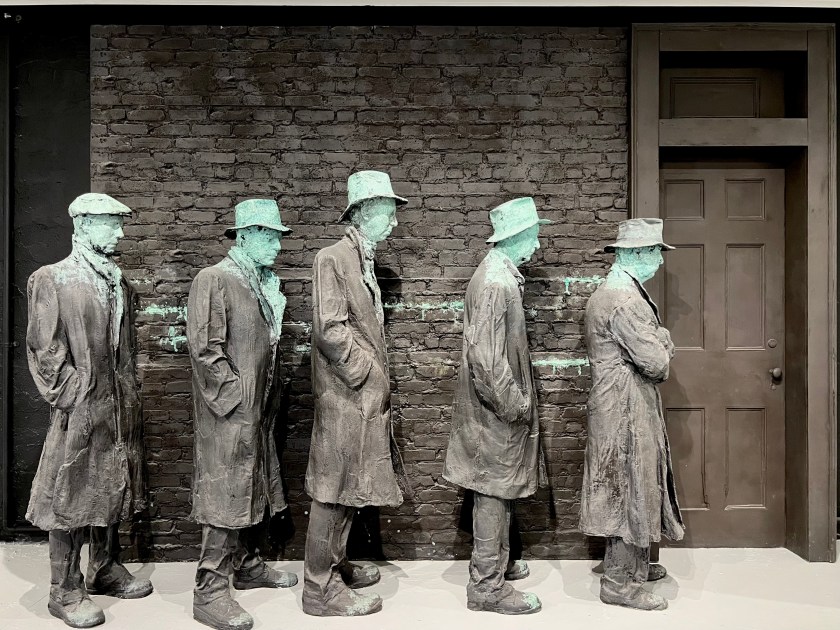
SEGAL. DEPRESSION BREADLINE, 1991.
George Segal is recognized for his innovative incorporation of plaster casts in life size sculptures.
“Segal’s placement of life-size figures in an environment, a trope for which he became best known, was further developed in July 1961, when he was asked to write about newly developed gauze and plaster Johnson & Johnson bandages as a potential new art material. He was given boxes of the medical material, which he took home and had his wife plaster around him while he sat in a chair. The results led him to continue using different versions of the material to make full-body plaster casts directly from the figures of his family, friends, colleagues, and patrons. These figures were then placed on the ground in relationship to ready-made objects often taken from the urban landscape. While the surfaces of his sculptures were often left white, Segal also occasionally incorporated bright hues into his pieces.” Guggenheim Museum
“The sculpture is a bronze cast of a piece Segal was commissioned by the federal government to create for the Franklin Delano Roosevelt Memorial in Washington D.C. Designed by Lawrence Halperin, in a sequence of four outdoor rooms, the memorial traces the history of the United States during the twelve years of FDR’s Presidency. Segal’s three scenes portray the mood of the county during the Great Depression: Rural Couple, Fireside Chat, and Depression Breadline. The artist patiently worked through the commission process for many years, even as construction of the memorial became bogged down in political and monetary controversy. The memorial was finally dedicated in 1997 during the Clinton administration, thanks in part to the efforts of Senators Daniel K. Inouye of Hawaii and Mark O. Hatfield of Oregon, whose dedication ensured that the memorial was completed.” The Margulies Collection
“I see one-third of a nation ill-housed, ill-clad, ill-nourished. The test of our progress is not whether we add more to the abundance of those who have much; it is whether we provide enough for those who have too little.” Engraved in granite next to the Depression Breadline are the words of Franklin Delano Roosevelt, January 20, 1937.
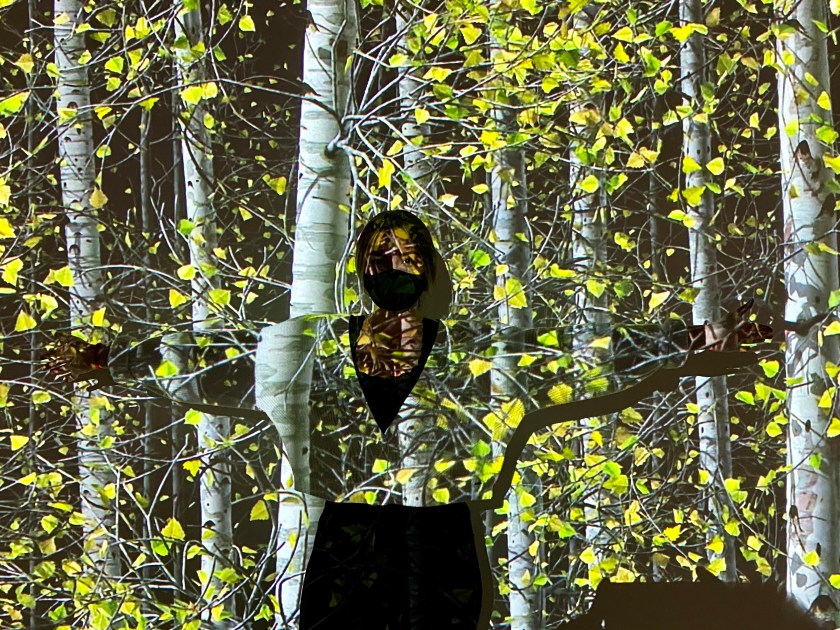
STEINKAMP. BLIND EYE 3, 2019.
“Blind Eye engages with one of the oldest themes in art history-nature and landscape. Blind Eye depicts the seasonal phases of a birch grove. The composition is a play on monocular perspective, an inter-exchange of a multiple gaze. I am fascinated by the recent discoveries that trees communicate through an underground chemical exchange…You can certainly sense the incorporeal in nature. If anything, this is a consistent current in my work. There is so much we can just barely sense and feel; I believe we are surrounded by sentience. I use the tangible invisible forces in air to communicate this, for example, an invisible wind is revealed by the trees movement in Blind Eye. The title Blind Eye is a play on words: it refers to a tree blind; it also conveys the singular eye scars left on birch trees after they lose their branches; it is seeing with one eye, or monocular vision; there are so many things we turn a blind eye to these days, Trump pulling out of the Paris Agreement is among the most hideous. We are dumping carbon and methane gases into the atmosphere, changing the climate at exceeding rates.” Jennifer Steinkamp
REFERENCES AND FURTHER READING
Art21
Guggenheim Museum
Margulies Collection at the Warehouse
The Metropolitan Museum of Art
EDITORS AND LAST UPDATE
John William Bailly 12 April 2023
COPYRIGHT © ALL RIGHTS RESERVED
 Bailly Lectures