
“Ever since acquiring their first work in 1964, Don and Mera Rubell have made a name for themselves as some of the most respected contemporary art collectors in the U.S. To this day they rely only on their eye and intuition—no art advisers allowed—to guide their approach to collecting, which has got them in the door early with artists including Keith Haring, Jeff Koons, Yayoi Kusama, and Cady Nolan.” Alexandra Bergman, https://www.architecturaldigest.com/story/annabelle-selldorfdesigned-rubell-museum-opens-in-miami

RUBELL MUSEUM
‘The Rubell Museum represents a new kind of institution serving as an advocate for a diverse mix of contemporary artists and resource for both the public and art world to engage in a dialogue with them. Since the Rubells moved to Miami 30 years ago, many museums and public collections have opened and the city has developed a vital arts ecology. They see their new museum as providing a context for art and exhibitions that are available to the public in South Florida and beyond. The new facility also enable the Rubell Museum to show a unique sweep of contemporary art that cannot be found anywhere else, ranging from seminal works by artists the Rubells first met over 50 years ago and works by artists they just met last week.” https://rubellmuseum.org/about-us/main-about-us
ACCESS
1100 NW 23 ST
Miami, FL 33127
(305) 573-6090
info@rubellmuseum.org
https://rubellmuseum.org/miami
There is a second location of the Rubell Museum in Washington, DC.
HISTORY
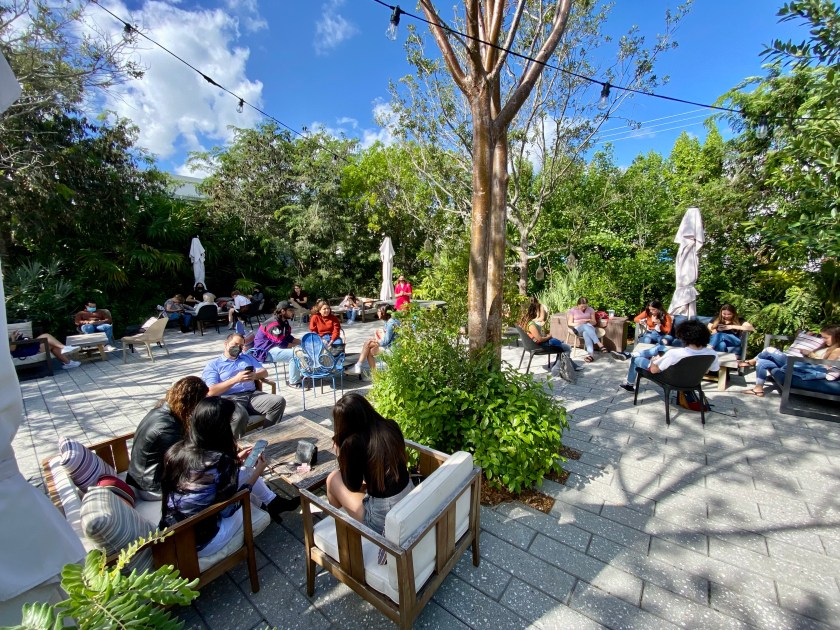
“The Rubell Museum opened in Miami’s Allapattah neighborhood in December 2019. Its new home was previously six interconnected industrial buildings that were then transformed by Selldorf Architects. Originally launched in 1993 as the Rubell Family Collection, the institution was renamed the Rubell Museum to emphasize its public mission and expand access for audiences. The Museum experience unfolds on a single level, with 36 galleries, a flexible performance space, an extensive research library, a bookstore, and an indoor-outdoor Basque restaurant LEKU, that opens onto a courtyard garden filled with plants native to South Florida.” https://rubellmuseum.org/miami/about-rubell-museum-miami
ARTIST-IN-RESIDENCE PROGRAM
“In recent years, the Museum has continued to expand its programming to share both new acquisitions and highlights from the collection, as well as works developed by its artists-in-residence, a position most recently held by Alexandre Diop. This year’s presentations represent a continuation of our mission to spotlight a diverse mix of contemporary artists while encouraging public dialogue. Works on view include both significant pieces by artists our family has engaged with over decades, as well as exciting work by artists we have recently interacted with during studio visits, and from whom we have commissioned bodies of work.” Jason Rubell

The Rubell Museum offers an Artist-in-Residence program that annually hosts a different artist. The 2022 Artist-in-Residence was Franco-Senegalese artist Alexandre Diop. Diop “uses discarded objects to create work that raises questions pertaining to sociopolitical, cultural and gender issues. Drawing inspiration from his European and African roots, he explores the legacies of colonialism and diaspora while tackling universal themes of ancestry, suffering, and historical violence.” https://rubellmuseum.org/2022-alexandre-diop
SELECTED WORKS FROM THE PERMANENT COLLECTION
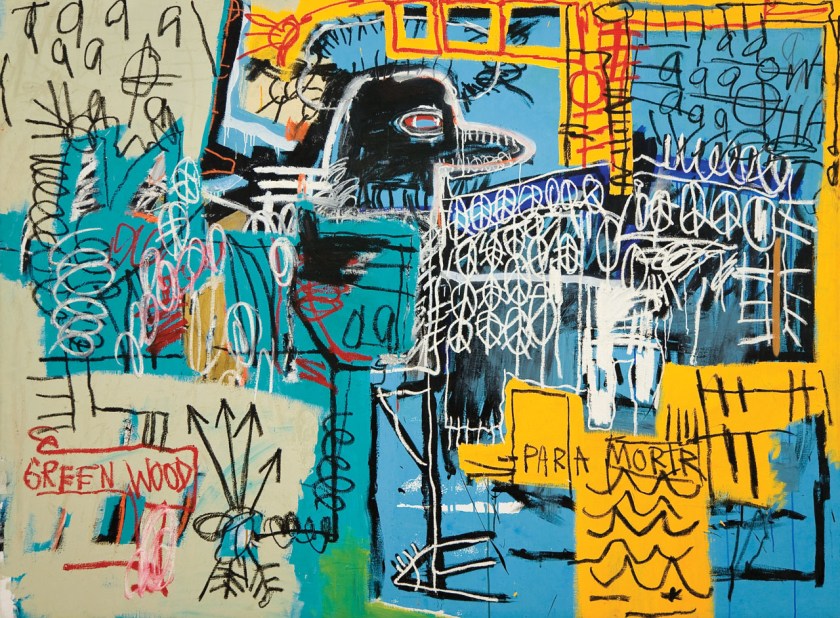
BASQUIAT. BIRD ON MONEY, 1981.
“His (Basquiat) color-drenched canvases are peopled with primitive figures wearing menacing masklike faces, painted against fields jammed with arrows, grids, crowns, skyscrapers, rockets and words. ”There are about 30 words around you all the time, like ‘thread’ or ‘exit,’ ” he explains. He uses words ”like brushstrokes,” he says. The pictures have earned him serious critical affirmation. In reviewing a group show of drawings last year, John Russell, chief art critic of The New York Times, noted that ”Basquiat proceeds by disjunction – that is, by making marks that seem quite unrelated, but that turn out to get on very well together.” https://www.nytimes.com/1985/02/10/magazine/new-art-new-money.html
In 2020, musical band The Strokes used Basquiat’s Bird on Money as the cover for their album The New Abnormal.

CATTELAN. LA RIVOLUZIONE SIAMO NOI (WE ARE THE REVOLUTION), 2000.
“Maurizio Cattelan is the contemporary art world’s court jester. While his art-historical predecessor may be the Dadaist punster Marcel Duchamp, Cattelan is heir to a much broader tradition—that of the clown, a tragicomic figure with a particular resonance in the artist’s native Italy, birthplace of commedia dell’arte and the films of Federico Fellini and Roberto Benigni. Playing the role of the loser with great relish, Cattelan continuously pretends to sabotage his own chances for success and recognition. Claiming to have no ideas, he once fled an exhibition venue by climbing out a window and lowering himself down a knotted sheet. In another instance, the artist sold his allotted space at the Venice Biennale to a perfume company, which placed an advertisement for its product in the gallery…In La Rivoluzione Siamo Noi (We are the revolution), a miniature effigy of the artist hangs from a Marcel Breuer–designed clothing rack…Cattelan’s “mini-me” occupies a large, otherwise empty gallery and appears to cower sheepishly, seemingly embarrassed that he did not have more ideas for the exhibition…Cattelan uses his own image to bear meaning in his work, and his perpetual claim “I am not really an artist,” is simply an inversion of Beuys’s declaration that “every man is an artist.” Cattelan…is a trickster who stirs up trouble in an all-too-complacent world. But this dichotomy proves false. In alchemical lore, the trickster character is both a shaman and a prankster who can transform himself at will in order to work his magic.” https://www.guggenheim.org/artwork/9421
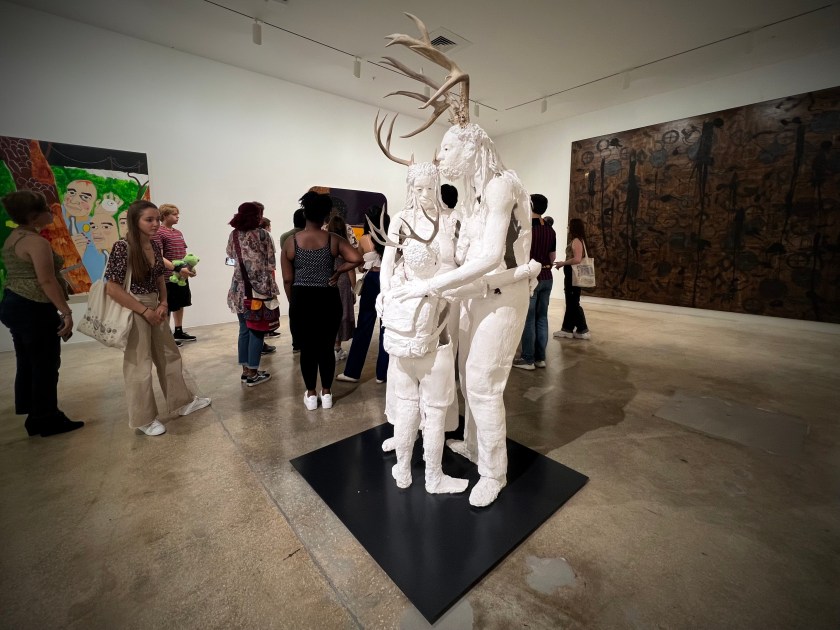
DAVIS. FAMILY, 2019.
“Karon Davis (b. 1977, Reno, Nevada) creates sculptures and multimedia installations that touch on issues of history, race, and violence in the United States, using materials as varied as plaster strips, chicken wire, glass, and readymade objects. Drawing on her background in theater and film, Davis creates haunting tableaux inhabited by protagonists both historical and imagined. The figures are created using the artist’s unique plaster method, amalgamations of life-size casts taken from friends and family as well as her own body. The material reflects her longtime interest in ancient Egyptian mummification practices, using wrapping to memorialize different bodies and their complex histories.” https://salon94.com/artists/karon-davis/

JINSHI. POWER AND KINGDOM, 2007-2010.
“Zhu Jinshi produces abstract paintings whose surfaces are built up with thick, near-sculptural layers of oil paint. Resembling colorful landscapes, Zhu’s images range in palette and scale, but the artist is known to always apply his oil paint with spatulas and shovels. Producing dense lashings of color, the artist’s method recalls the style and techniques espoused by the German Expressionists, who Zhu was profoundly influenced by during his years living in Berlin. Zhu belonged to a group of Chinese avant-garde artists named the Stars, which formed in 1979 to challenge aesthetic conventions and exhibit their work publicly. The group, which included the famous dissident artist Ai Weiwei, was granted an exhibition in 1980 at Beijing’s National Gallery, a breakthrough in Chinese cultural expression that helped to establish the creative force of the individual. “Although I operate within the realm of form,” Zhu has said, “my idea is to go beyond the limitations set by form and break free.” He has also produced photographic, video, installation, and performance works.” https://www.artsy.net/artwork/zhu-jinshi-the-three-kingdoms-strategy

KUSAMA. INFINITY MIRRORED ROOM – LET’S SURVIVE FOREVER, 2017.
Yayoi Kusama’s celebrated, fully immersive installations create a kaleidoscopic effect that transports visitors to an alternate, limitless universe. The Rubell currently hosts the Infinity Rooms Where the Lights in My Heart Go, 2016 and INFINITY MIRRORED ROOM – LET’S SURVIVE FOREVER, 2017. “Kusama’s Infinity Rooms take us to new galaxies,” said Mera Rubell. “We are honored to be the only museum in the country with three of her major interactive works on view, each of which provides a different transformative experience. Her works are accessible and enjoyable for visitors of all ages which goes to the heart of our mission of sharing our collection.”

MURAKAMI. DOB IN THE STRANGE FOREST, 1999.
Takashi Murakami (born 1692, Tokyo) challenges traditional notions notions of high and low art.
Asked by Magdalene Perez about straddling the line between art and commercial products, Murakami responded: “I don’t think of it as straddling. I think of it as changing the line. What I’ve been talking about for years is how in Japan, that line is less defined. Both by the culture and by the post-War economic situation. Japanese people accept that art and commerce will be blended; and in fact, they are surprised by the rigid and pretentious Western hierarchy of “high art.” In the West, it certainly is dangerous to blend the two because people will throw all sorts of stones. But that’s okay—I’m ready with my hard hat.”
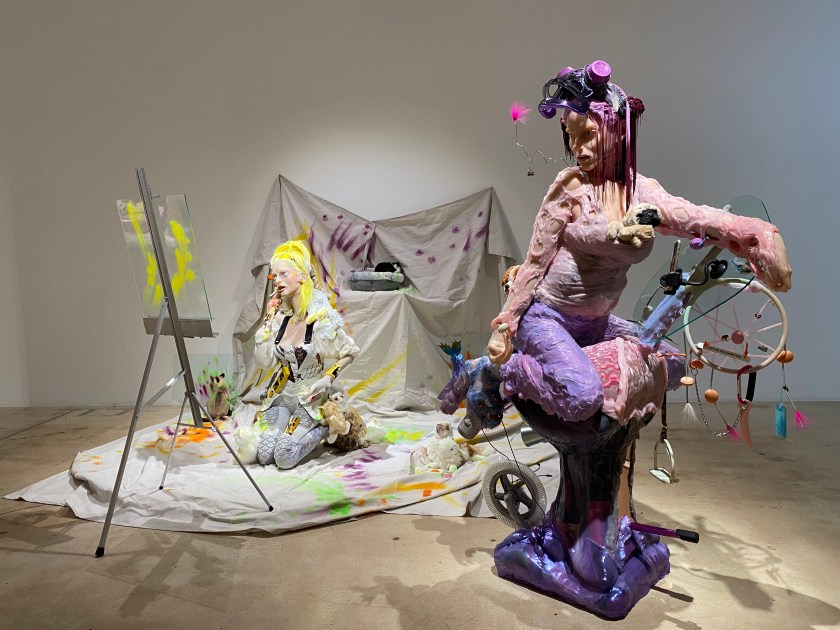
VON ZEIPEL. COLLECTION OF MULTIPLE WORKS, 2019-2021.
“Cajsa von Zeipel (b. 1983, Gothenburg, Sweden / lives and works in New York, NY) works between desire, seduction, and the grotesque to defy traditional representations of gender. Her silicone sculptures of dramatically adorned figures and contorted figures delve into identity, queerness, normativity, and fantasy.” https://rubellmuseum.org/97-miami/exhibitions/1334-2021-cajsa-von-zeipel
“Cajsa von Zeipel is a sculptor whose work delves into identity, gender, queerness and normativity. She has become known for her white, large-scale plaster sculptures but in her recent works she has left the reference to classical sculpture and developed an even more complex technique. von Zeipel constructs her female figures in pastel coloured silicone in an evocation of sci-fi and fantasy aesthetics. The silicone – a material that is common in implants, sex toys, and kitchen equipment – brings her sculptures to life. Beneath the silicone there are parts of mannequins, objects that are typically used to construct desire in capitalist spaces. Sawing off limbs and reconnecting disparate pieces, von Zeipel destroys their normative bodies; rather than statically holding clothes, these reconfigured forms take on uncanny movements. Limbs shake, fingers bend, skin wrinkles, and mouths fall in a manner that mimics our own physicality. Cajsa von Zeipel’s technical prowess is evident in these extra-terrestrial sculptures. As opposed to her earlier tall, white sculptures in plaster and jesmonite the new ones are messy and almost grotesque. They seem to float beyond their human boundaries becoming futuristic bodies merging the human body with all kinds of stuff becoming a new kind of species. An assertion of femme visibility and sex positive provocation, von Zeipel’s works celebrate a world of their own creation.” https://www.andrehn-schiptjenko.com/artists/42-cajsa-von-zeipel/
REFERENCES AND FURTHER READING
EDITORS AND LAST UPDATE
John William Bailly 12 April 2023
COPYRIGHT © ALL RIGHTS RESERVED
 Bailly Lectures