
NORTON MUSEUM OF ART
“The museum is often most enjoyable when it flaunts its disjointedness instead of trying to sweep it under the rug.” Jackson Arn
ACCESS
Norton Museum of Art
1450 South Dixie Highway
West Palm Beach, FL 33401
561.832.5196
Norton Museum of Art
$5.00 admission for students with valid school ID
HISTORY
“The Norton Museum of Art was founded in 1941 by Ralph Hubbard Norton (1875-1953) and his wife Elizabeth Calhoun Norton (1881-1947). Norton was an industrialist who headed the Acme Steel Company in Chicago. He and his wife began collecting to decorate their home, but then he became interested in art for its own sake and formed a sizable collection of paintings and sculpture. In 1935, Mr. Norton semi-retired, and the couple began to spend more time in the Palm Beaches. They contemplated what to do with their art collection and eventually decided to found their own museum in West Palm Beach, to give South Florida its first such institution. In 1940, construction began on the Norton Gallery and School of Art located between South Olive Avenue and South Dixie Highway in West Palm Beach. Mr. Norton commissioned Marion Sims Wyeth of the distinguished firm of Wyeth, King & Johnson to design the Museum. The Art Deco building opened to the public on February 8, 1941. Norton continued to add to his collection until his death in 1953, and the works that he and his wife gave the Museum form the core of the institution’s collection today. The Museum’s permanent collection now consists of more than 8,200 works in five curatorial departments: European, American, Chinese, Contemporary and Photography. Since 1954, many distinguished additions have been made thanks to the endowment Mr. Norton created for the purchase of works of art.” Norton Museum of Art
BAILLY LECTURE NOTES FOR THE NORTON ART MUSEUM
The Norton Museum of Art in West Palm Beach offers students the opportunity to trace the trajectory of Western European art from the 1300s to the present day. The Norton provides a unique learning environment in Southeast Florida for students. No other museum offers the opportunity to witness history through objects rather than print or digital reproductions. That’s why we drive here from Miami.
The selection of works below is listed in chronological order.
The following four paintings of the Virgin Mary trace the development of European art (specifically Italian) from the Byzantine influence on Gothic art of the medieval era to the naturalism of the Renaissance to the dynamic compositions of the Baroque.

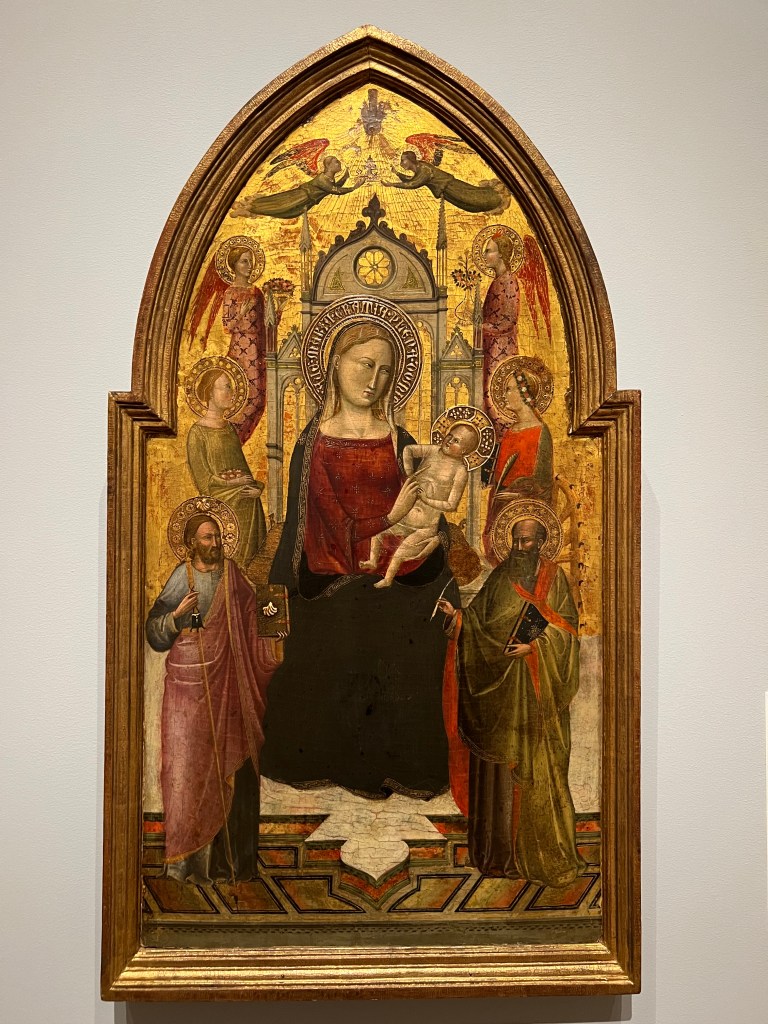
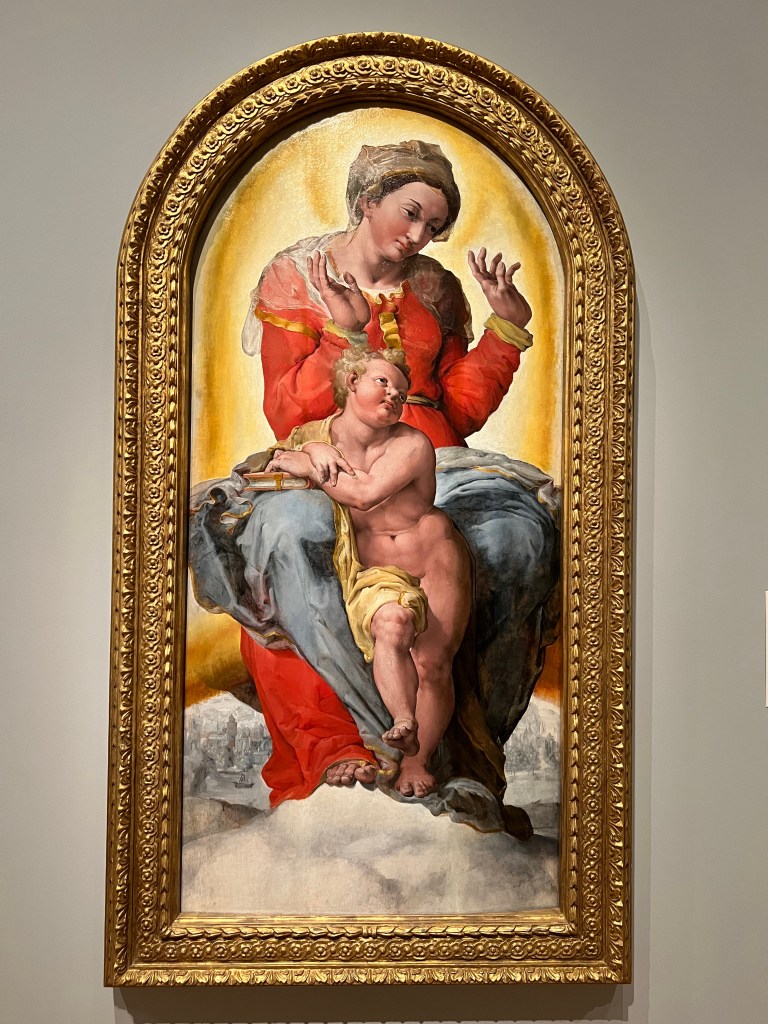

“The term ‘renaissance’ is often used to designate a rebirth of interest in the ancient Greek and Roman worlds (often referred to as ‘classical antiquity’) that arose in Europe in the later Middle Ages. While engagement with the Greco-Roman past was not new, it took on a new urgency in Italy beginning in the fourteenth century and was eventually felt throughout the European continent. This interest prompted new intellectual investigations (learn about humanism) that had a profound influence on European culture, affecting all realms of life including the visual arts. Many of the artistic traditions originating or maturing in this context informed the direction of European art for the next several centuries. Linear perspective, volumetric figures rendered with anatomical precision, emotionally charged expression, and visual naturalism are formal elements popularized in the Renaissance.” Dr. Heather Graham on smartarthistory
NOSADELLA. MADONNA AND CHILD IN GLORY, CIRCA 1563.
Giovanni Bezzi, or Nosadella, as he was known, was a Bolognese pupil of Pellegrino Tibaldi, a Mannerist or late Renaissance painter taught by Perino del Vaga, who was Raphael’s second most important pupil in Rome. One of the salient features of the work is the contrast between the extraordinarily beautiful rose of the Virgin’s robe and the pale blue of the shawl across her knees. These contrasting pale colors are a bit of a commonplace in Mannerism, but are always notable when used exceedingly well, as they are here. You’ll also notice the Christ Child is not the perfect toddler of Florentine painters – he’s a little fleshier and sturdier, a little homelier. The Virgin’s gesture also seems a little demonstrative, more suitable maybe to a more dramatic subject. It seems as if what is lost in the ideal is, however, gained in expressiveness. Something of the tradeoff between the two is suggested by Carlo Malvasia, the great 17th century historian of Bolognese painting, who wrote “those few works by him [that is, Nosadella] that are known–and they are mostly frescos–are distinguished by their good color …and are full of erudition. If they are not as perfect and studied [as those of Tibaldi, his master], they are perhaps more powerful, singular, and resolute.” Carlo Cesare Malvasia, Felsina pittrice. Vite de’ pittori bolognesi, 1678. Norton Museum of Art
GIORDANO. THE IMMACULATE CONCEPTION, 1657.
“Luca Giordano was one of the leading Neapolitan painters of the Baroque. His style was initially indebted to that of his teacher, the Spanish artist Jusepe de Rivera (1591 – 1652), who worked in Naples. However, a trip through Italy shortly after 1650 exposed him to Roman painters like Pietro da Cortona and to the Venetian tradition of color, both of which led him to a more luminous and decorative manner, as in this signed and dated altarpiece. The work’s title refers to a new, Counter-Reformation doctrine whereby the Virgin herself was said to be immaculately conceived. The white robe and blue cloak are details from this new interpretation, in which every object and motif has some symbolic meaning: a mirror as a symbol of virginity, a lily of the valley as a symbol of purity, and so forth.” Norton Museum of Art

RUBENS. STUDY FOR HEAD OF SAINT JOHN THE EVANGELIST, CIRCA 1611-1612.
This preparatory study for the head of Saint John the Evangelist in Rubens’s monumental triptych The Descent from the Cross (1611–1614 in the Cathedral of Antwerp is considered to be wholly by Rubens’ hand. Rubens ran perhaps the largest painting studio of the age, a factory almost, with a well-structured division of labor and many assistants. He was pretty much the official painter of the Catholic counter-reformation and the go-to artist for official portraits and large ecclesiastical commissions. His grand manner not only reshaped religious imagery (and many other kinds too) but spread throughout the Catholic world. This study is notable for its over-the-shoulder point of view, its modulation of light and shadow, the undulating rhythm and highlights of the hair – all elements that give it freshness and vivacity. But radical changes could occur. Ironically, the final version in the altarpiece alters the position of the head, darkens the color of the hair and obliterates much of the detail that give the study its appeal. Was it the demands of scaling up or simply the need for quick execution? Perhaps for an artist in tremendous demand, it was a bit of both.” Norton Museum of Art
Rubens is a Baroque artist. “Baroque painting most typically depicted Biblical and mythological allegories on a grand scale with strong contrast between light and shadow, richly saturated colours, a compelling evocation of activity, and sumptuous brushwork…Baroque art provokes passion, awe, and reverence, in sharp contradistinction to the more cerebral, classically-inflected work that defined the High Renaissance a century before and the Neoclassical period a century later.” Sotheby’s
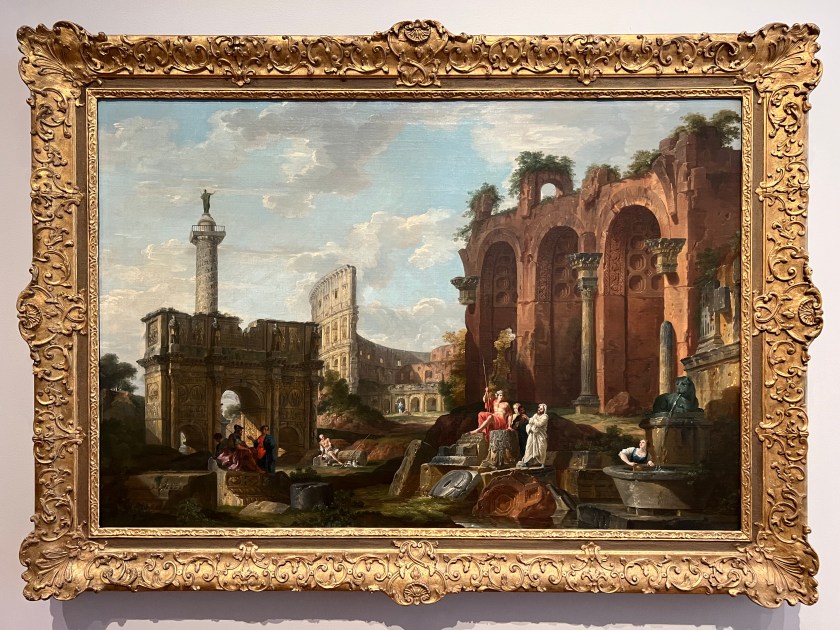
PANINI. CAPRICCIO WITH MONUMENTS OF ROME, CIRCA 1775.
“The architectural capriccio (fantasy) differed from the veduta (view painting) in that it abandoned the authority of the map and juxtaposed a variety of famous buildings in imaginary arrangements for the sole purpose of delighting the viewer. The painter and architect Panini was adept at both types. This capriccio brings together an ambitious assemblage of the Colosseum, Trajan’s Column, the Arch of Constantine, and the Baths of Caracalla — all monuments one might see in an hour’s walk through downtown ancient Rome. Panini also served as a professor of optics at the French Academy, Rome. The renowned French architectural painter Hubert Robert was one of his studio assistants.” Norton Museum of Art
Panini’s painting notes the shift in European art from the Baroque to the Neoclassical.
“Neoclassicism is characterized by clarity of form, sober colors, shallow space, strong horizontal and verticals that render that subject matter timeless (instead of temporal as in the dynamic Baroque works), and classical subject matter (or classicizing contemporary subject matter).” Dr. Beth Gersh-Nesic on smartarthistory

“Despite differing in age, technique, training, and lifestyle, the artists of the Barbizon School collectively embraced their native landscape, particularly the rich terrain of the Forest of Fontainebleau. They shared a recognition of landscape as an independent subject, a determination to exhibit such paintings at the conservative Salon, and a mutually reinforcing pleasure in nature. Alfred Sensier, close friend and biographer of Barbizon painters Théodore Rousseau and Jean-François Millet, wrote of the romantic attraction of the Forest of Fontainebleau: “They had reached such a pitch of over-excitement that they were quite unable to work… the proud majesty of the old trees, the virgin state of rocks and heath… all these intoxicated them with their beauty and their smell. They were, in truth, possessed.” Metropolitan Museum of Art
“Although he never resided in the village for which it was named, Henri-Joseph Harpignies is considered a member of the Barbizon School because he shared their emphasis on the direct experience of nature and love of rural scenery. He was particularly close to Corot, with whom he traveled to Italy. Unlike the Impressionists, for whom the Barbizon artists held considerable importance, he was not solely interested in the purely optical effects of light and color. In addition to effects of light, he gave considerable importance to the contours, textures, and details of his subjects, as can be seen in this bright picture in which the female figure is but a faint presence in the landscape.” Norton Museum of Art

“Of the artists who joined Corot in the French countryside in the summer months, Charles-François Daubigny was among the most accomplished. Whether painting storks hovering over a marsh or an apple orchard swaying in the wind, he brought his canvases to a radical degree of completion outdoors. Daubigny worked in the Forest of Fontainebleau in his early years, but his preference for water soon led him to other regions of France. From his floating studio, a refitted ferry called Le Bottin (The Little Box), Daubigny ambled along the Oise River painting transient skies and limpid waters.” Metropolitan Museum of Art
“Born into a family of painters, Charles-François Daubigny moved in 1843 to Barbizon in order to paint out of doors with like-minded artists like Jean- Francois Millet, Théodore Rousseau, and Jean-Baptiste-Camille Corot. He has the distinction of being the first important artist to convert a houseboat into a floating studio (also done later by Monet), to help him capture the watery subjects he preferred. This work is an excellent example of the late first phase of Daubigny’s work, which is distinguished by glassy surfaces and a preoccupation with light and reflection. It also shows a hint of the rougher textures and thicker paint he would adopt from Courbet, who he met two years earlier.” Norton Museum of Art
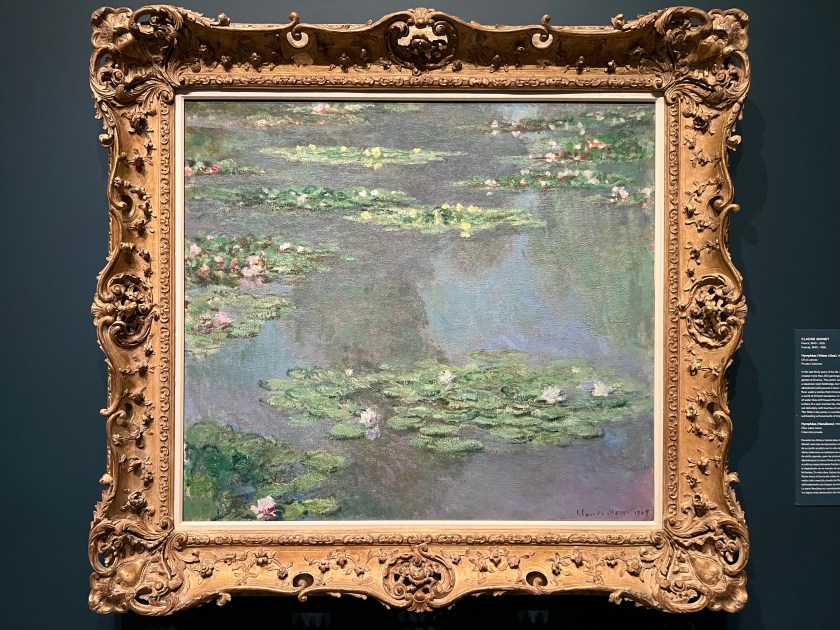
MONET. NYMPHÉAS, 1905.
“In their landscapes and genre scenes, the Impressionist tried to arrest a particular moment in time by pinpointing specific atmospheric conditions—light flickering on water, moving clouds, a burst of rain. Their technique tried to capture what they saw. They painted small commas of pure color one next to another. When viewer stood at a reasonable distance their eyes would see a mix of individual marks; colors that had blended optically. This method created more vibrant colors than colors mixed as physical paint on a palette. An important aspect of the Impressionist painting was the appearance of quickly shifting light on the surface of forms and the representation changing atmospheric conditions. The Impressionists wanted to create an art that was modern by capturing the rapid pace of contemporary life and the fleeting conditions of light. They painted outdoors (en plein air) to capture the appearance of the light as it flickered and faded while they worked.” Dr. Beth Gersh-Nesic on smartarthistory

GRIS. LE JOURNAL, 1916.
“Cubism was one of the most influential styles of the twentieth century. It is generally agreed to have begun around 1907 with Picasso’s celebrated painting Demoiselles D’Avignon which included elements of cubist style. The name ‘cubism’ seems to have derived from a comment made by the critic Louis Vauxcelles who, on seeing some of Georges Braque’s paintings exhibited in Paris in 1908, described them as reducing everything to ‘geometric outlines, to cubes’. Cubism opened up almost infinite new possibilities for the treatment of visual reality in art and was the starting point for many later abstract styles including constructivism and neo-plasticism. By breaking objects and figures down into distinct areas – or planes – the artists aimed to show different viewpoints at the same time and within the same space and so suggest their three dimensional form. In doing so they also emphasized the two-dimensional flatness of the canvas instead of creating the illusion of depth. This marked a revolutionary break with the European tradition of creating the illusion of real space from a fixed viewpoint using devices such as linear perspective, which had dominated representation from the Renaissance onwards.” Tate Modern
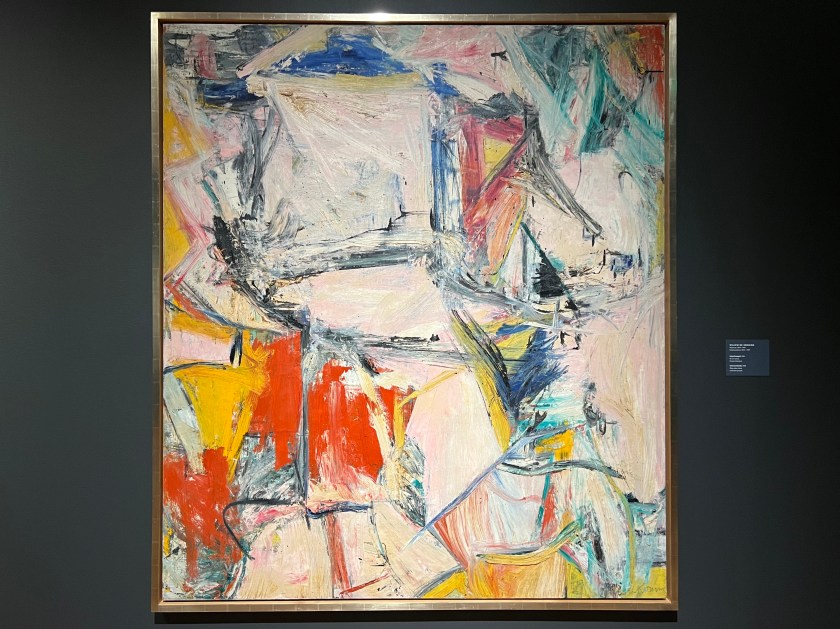
DE KOONING. INTERCHANGED, 1955.
“Most Abstract Expressionist paintings are large scale, include non-objective imagery, lack a clear focal point, and show visible signs of the artist’s working process, but these characteristics are not consistent in every example. In the case of Willem de Kooning…the visible brush strokes and thickly applied pigment are typical of the “Action Painting” style of Abstract Expressionism also associated with Jackson Pollock and Franz Kline…we can easily imagine de Kooning at work, using strong slashing gestures, adding gobs of paint to create heavily built-up surfaces that could be physically worked and reworked with his brush and palette knife.”…Born in the Netherlands, de Kooning was trained in the European academic tradition unlike his American colleagues. Although he produced many non-objective works throughout his career, his early background might be one factor in his frequent return to the figure.” Dr. Virginia B. Spivey smartarthistory

CAVE. SOUNDSUIT, 2010.
“Nick Cave was born in Fulton, Missouri in 1959. He creates “Soundsuits”—surreally majestic objects blending fashion and sculpture—that originated as metaphorical suits of armor in response to the Rodney King beatings and have evolved into vehicles for empowerment. Fully concealing the body, the “Soundsuits” serve as an alien second skin that obscures race, gender, and class, allowing viewers to look without bias towards the wearer’s identity. Cave regularly performs in the sculptures himself, dancing either before the public or for the camera, activating their full potential as costume, musical instrument, and living icon. The artist also works with choreographers, dancers, and amateur performers to produce lavish community celebrations in untraditional venues for art. Dazzling in their movement, Cave’s sculptures are crafted in collaboration with artisans from a dizzying array of materials that include beads, raffia, buttons, sequins, twigs, fur, and fabric. The “Soundsuits” are also displayed in exhibitions as static sculptures, arranged as groups of figures in formation that are striking in their diversity and powerful stance.” art21
REFERENCES AND FURTHER READING
Art History Teaching Resources (AHTR)
Metropolitan Museum of Art’s Heilbrunn Timeline of Art History


EDITORS AND LAST UPDATE
John William Bailly 12 April 2023
COPYRIGHT © ALL RIGHTS RESERVED
 Bailly Lectures