
THE COLLECTION
“The Frost Art Museum’s permanent collection includes over 6,000 objects with a strong representation of American printmaking from the 1960s and 1970s, photography, pre-Columbian objects dating from 200-500 AD, and a growing number of works by contemporary artists, especially from Latin American and Caribbean countries.” Frost Art Museum
Patricia & Phillip Frost Art Museum is part of Florida International University. FIU is part of the state university system of the State of Florida.
ACCESS
Patricia & Phillip Frost Art Museum
Modesto Maidique Campus
10975 SW 17th Street
Miami, FL. 33199
Admission to the Frost Art Museum is free for everyone!
FROST ART MUSEUM STAFF
Director: Jordana Pomeroy
Chief Curator: Amy Galpin
Assistant Curator: Yady Rivero
Education Curator: Miriam Machado
Education Assistant: Amaris Cruz-Guerrero
https://frost.fiu.edu/about/contacts/index.html
MISSION
“The Patricia & Phillip Frost Art Museum’s mission is to provide transformative experiences through art; collect, exhibit, and interpret art across cultures; and advance FIU’s stature as a top tier research university. Our vision is to spark curiosity and dialogue through art! As a Smithsonian Affiliate and one of the largest academic art museums in South Florida, the Frost Art Museum provides the community with free access to world-class art that spans cultures and time periods.” Frost Art Museum
TEMPORARY EXHIBITIONS
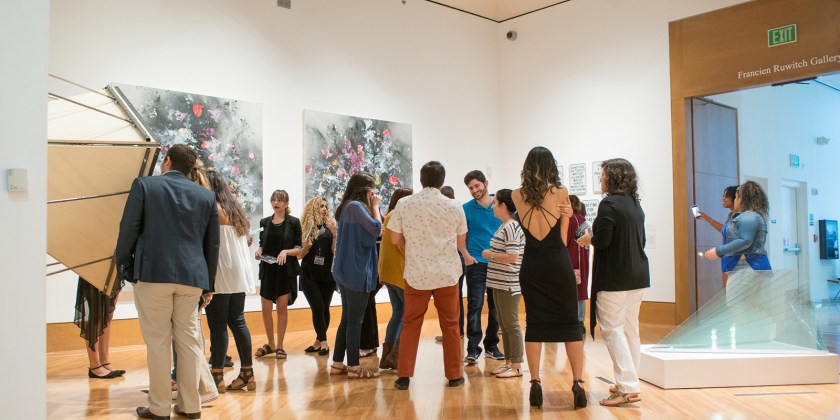
The Frost Art Museum primarily rotates temporary exhibitions, meaning visitors discover new art on every visit.
“The museum presents an exhibition schedule as diverse as Miami’s population. We showcase artists from around the world and across cultures, disciplines, and genres. As a free museum, we provide our Miami community with access to a phenomenal arts education. In addition, the museum also showcases emerging and established local artists in select exhibitions throughout the year.” Frost Art Museum
SELECTED WORKS FROM THE PERMANENT COLLECTION
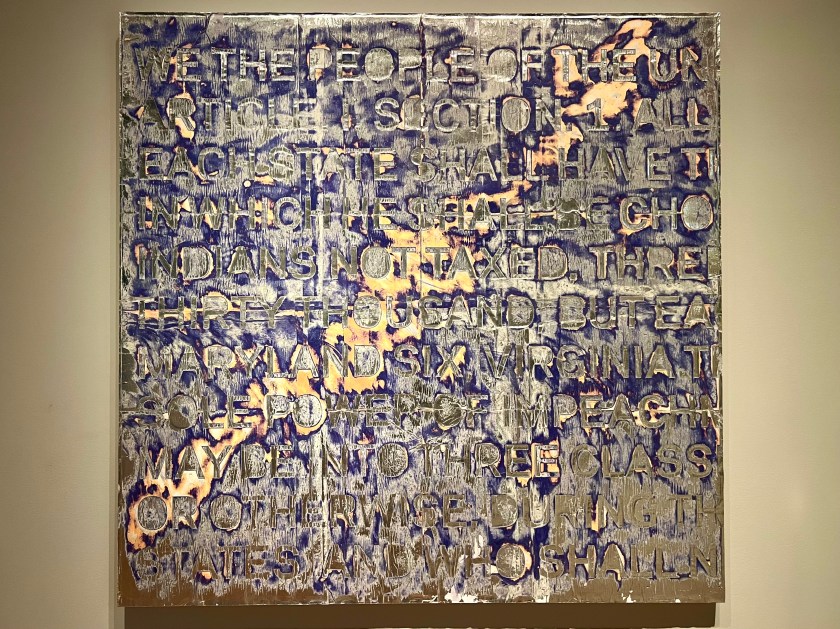
BRADFORD. IN WHICH HE SHALL BE, 2022.
“Born and raised in Los Angeles, Bradford credits his mother’s hair salon as a significant influence on his artistic practice. The salon called Banks’ Beauty Shop in South Los Angeles served as a meeting place for people from different backgrounds, to converse, share stories, and create a sense of community. Bradford’s mixed-media art and text-based imagery reflects the layered narratives and visual textures and patterns he encountered at the salon on beauty products and throughout his community in the form of posters and billboards. In which he shall be includes excerpts from the preamble and first article of the Constitution of the United States. These phrases refer to the appointment processes and eligibility requirements for members of Congress. Also taken from the first article, the title emphasizes the formal, legal tone characterizing the language found within the Constitution, a foundational legal document that establishes the framework of the U.S. government and the fundamental rights and liberties of its citizens. In this work, Bradford includes the fragmented words without context. The golden diagonal slash of paint alludes to burnt paper, suggesting wear and destruction.” Frost Art Museum
“In which he shall be, rendered through the liberal application of silver leaf and blue paint, presents eleven excerpts from the preamble and first article of the Constitution of the United States. These iconic and likely familiar phrases reference the counting and appointment processes as well as the selection and eligibility requirements for Congress. The concept of representation is emphasized in the title, as well, but the golden slash of paint which breaks apart the surface speaks to an imbalance that continues to have repercussions for citizens of this country. Bradford originally created In which he shall as a prototype for the London Embassy commission of We The People, 2017, a site-specific painting comprised of 32 ten-foot panels. This work builds upon Bradford’s practice of engaging complicated ideas of identity and representation through visually beautiful aesthetics. Here, rather than making an outright statement about the Constitution of the United States, which is both a symbol for peace but also a flawed document of its time, Bradford opens a conversation through visual cues.” Art Bridges
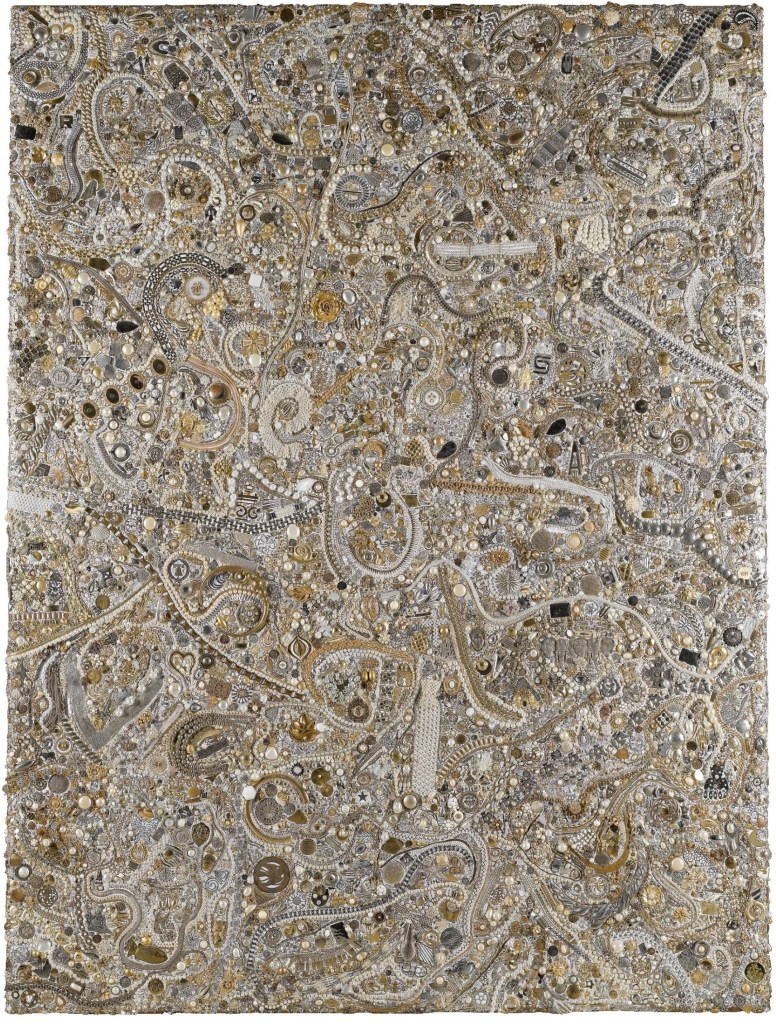
KELLEY. MEMORY WARE FLAT NO. 48, 2008.
“With its shimmering mosaic surface, Memory Ware Flat No. 48 provides a stunning exemplar of Mike Kelley’s celebrated eponymous series started in 2000. In the present body of works, Mike Kelley references the Canadian folk tradition of decorating common objects with miscellanea of items. Kelley translates this trivial practice into paintings of rare beauty where the surface is a collection of infinity colourful objects, such as buttons, pins, shells, costume jewellery and charms. By choosing common and often inexpensive trinkets, Mike Kelley meditates on their social role as sacral depository of fond memories not only in Canadian culture but in the all Western world. As explained by the artist, the “usage of this material seems appropriate given the ‘repressed memory’ references in my work.” (the artist cited in his statement accompanying the exhibition Detroit, Institute of Arts, Artists Take On Detroit, 2001)…In the Memory Ware Flat series, Kelley re-elaborates the idea of repressed memories in relation to the mnemonic properties of souvenirs used to decorate objects. Born in Detroit in 1954, Mike Kelley has been a pioneering point of reference for the Los-Angeles art scene since 1970s, working as well in music and being very involved in performance art, refusing to adapt to the language of Pop-Art in vogue at the time. Having already started to work with craft materials in 1980s, in the present series Kelley seeks to explore the process of the materialist ritual of collecting memory wares from which his paintings are generated. Kelley perceives the poetic of his art from critical reading aspects of reality. As he explained: “I have a more critical relationship to mass culture. I am not solely interested in arresting visuals; I am more interested in questioning the conventions of reading within a given genre.” (The artist cited in: John C. Welchman, et al., Mike Kelley, London 1999, p. 14). In the present work, Kelley masterfully translates his involvement in setting new parameters in Contemporary Art-discourse. Monumentally beautiful and attention-grabbing, Memory Ware Flat No. 48 is spectacular for the golden-reflective effect of its mosaics where the abstract uniformity of the composition is ruptured by the rich details of a variety of minute elements.” Sotheby’s
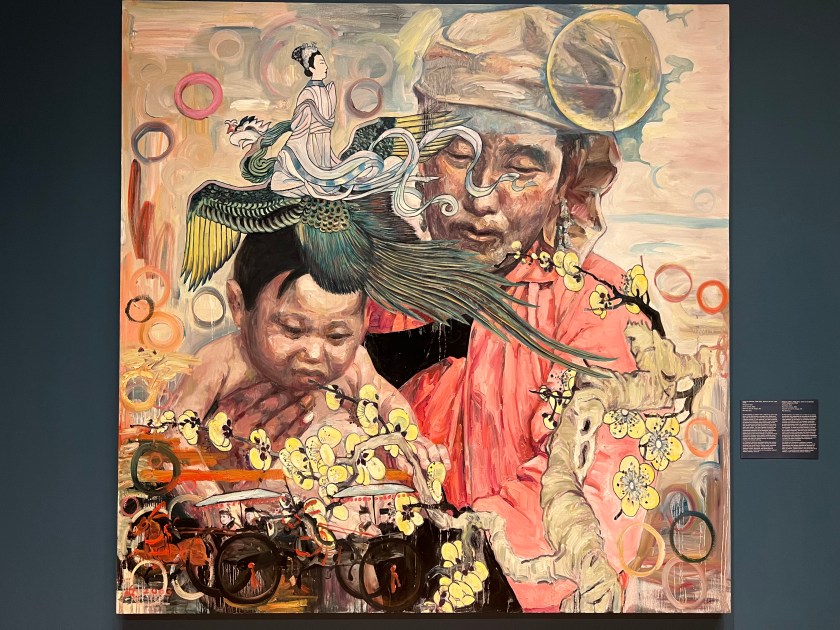
LIU. MONGOLIAN MOON, 2002.
“In this painting, a mother with a child in her arms look down at the Han Dynasty carriages from 2000 years ago with melancholy, as if they have traveled through a painful journey. In her paintings, Liu often employed symbols and metaphors. She created a visual language to express her sentiment about the passing of time and her experience fulfilling the dreams of her youth. The phoenix above the child serves as a metaphor of death and rebirth. The Moon Goddess (Chang’e) and the moon can be associated with Liu’s emotionally challenging experience as an immigrant: she flew far away as the new-born phoenix but the Goddess looking back at the moon indicates a longing for home. Yellow plum blossoms often signify resilience within moments of hardship. Depicted here surrounding the mother and child, the flowers convey an empathetic response to human suffering. Liu frequently portrays oppressed people and women in search of their social identities. Her use of smooth dripping lines recall tears or flowing water, particular to her memories as a child. “I hope to wash my subjects of their ‘otherness’ and reveal them as dignified, even mythic figures on the grander scale of history painting,” said Liu.” Frost Art Museum
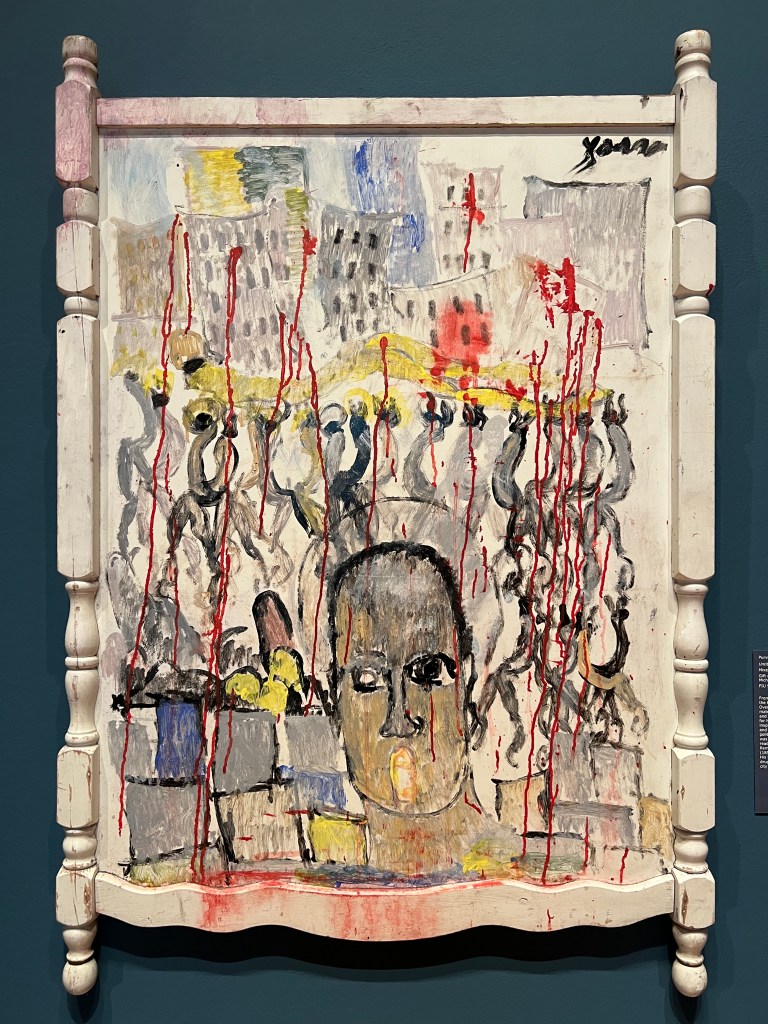
YOUNG. UNTITLED, 1988.
“From Miami, Purvis Young lived and worked in the historically Black neighborhood of Overtown. Young would make his works from materials he could find such as carpets, doors, and baby cribs. Young is primarily recognized for his large-scale mural-like installations, inspired by the mural movements in Chicago and Detroit. His works often tackled social and political issues, religion, and folklore. Young was most influenced by the Western artists he read about during his time in prison, namely Rembrandt (1606-1669), Vincent Van Gogh (1853-1890), and Paul Gauguin (1848-1903). His work also addressed society’s ills including drug addiction. Here, in this composition, the city itself bleeds onto the people below.” Frost Art Museum
PUBLIC ART AT FIU
https://frost.fiu.edu/collections/public-art/
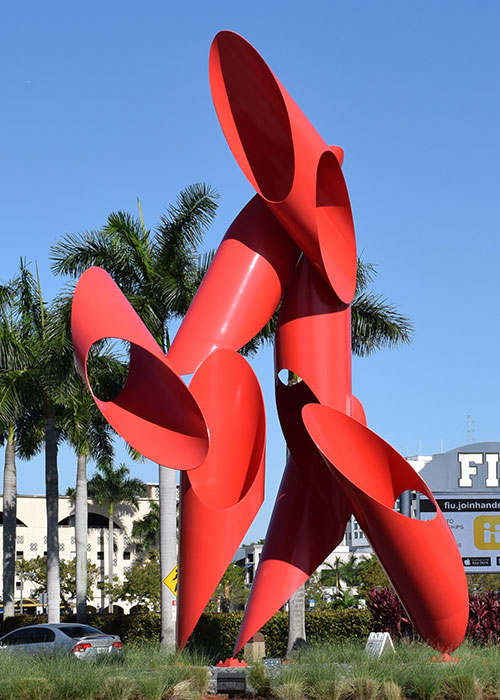
LIBERMAN. ARGOSY, 1980.
The Liberman sculpture was donated to FIU by Martin Z. Margulies of the Margulies Collection.
“Alexander Liberman, a Russian émigré had colorful, complicated, and far from conventional life. Because of his father’s Anti-Bolshevik leanings, the young Alexander boarded at school in London, and eventually joined his exiled parents in Paris. Liberman began his career in the early nineteen-thirties at a French magazine called VU, recognized for its innovative use of photography and type. He would eventually become the art director of VU, where he probably would have remained if not for the German invasion. Alexander and his wife Tatiana left occupied France in 1941 to settle in New York. Condé Nast hired Liberman for the art department at Vogue, and within a year he was the magazine’s art director. Liberman began painting and doing photography soon after his arrival in the US. By the early-1960’s Liberman was firmly ensconced in the NY art world and had begun exploring junk metal, old boilers and parts of tanks to make small-scale sculptures. His first public sculpture Prometheus was commissioned for the NY State Pavilion at the NY World’s Fair. From that major commission his career blossomed as a sculptor of large-scale works for public places. Considered a revolutionary Minimalist artist, Liberman’s fascination with American industrialization and modernization ultimately resulted in his widely known red steel sculptures and geometric paintings.” Frost Art Museum
REFERENCES AND FURTHER READING
EDITORS AND LAST UPDATE
John William Bailly 12 April 2023
COPYRIGHT © ALL RIGHTS RESERVED
 Bailly Lectures