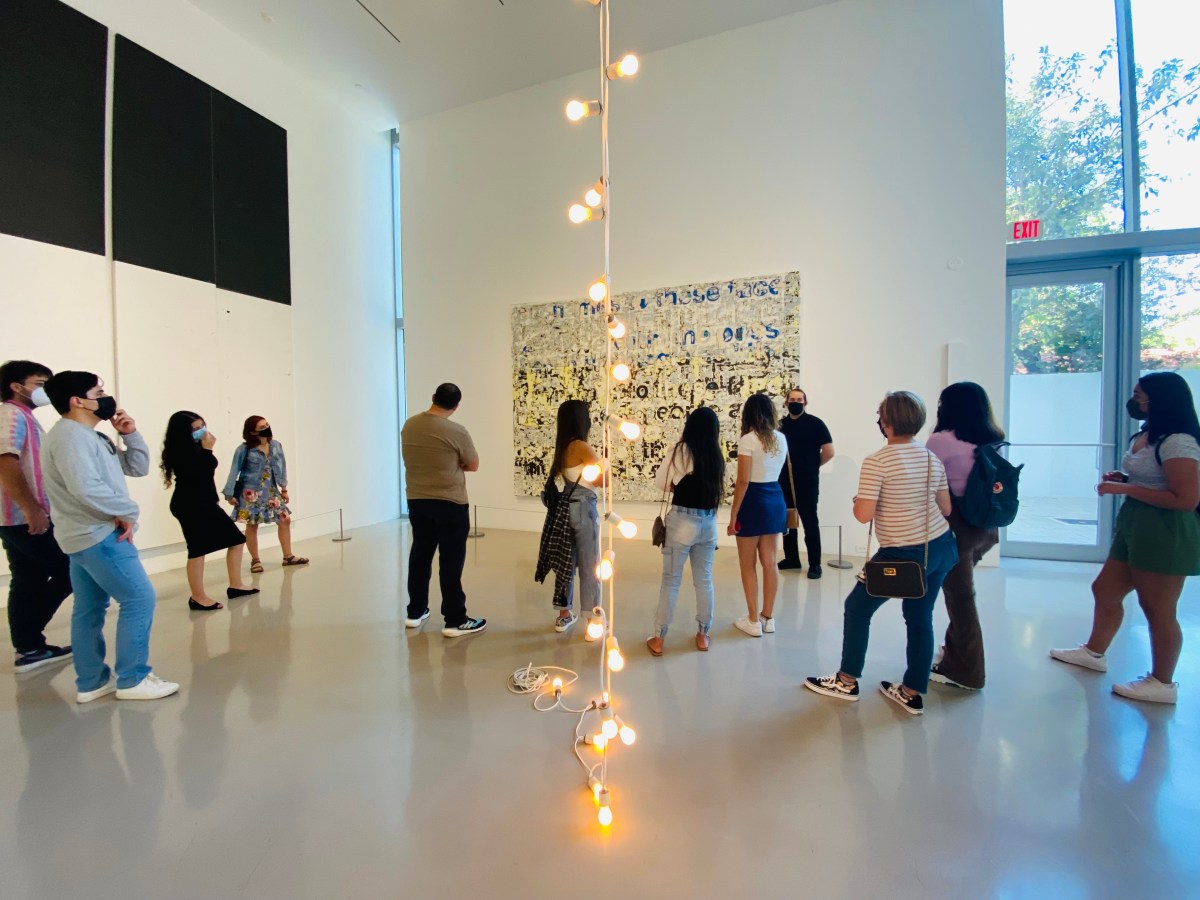
“We never limit the scope of the collection based on the medium in which an artist works, the place they are from or how the artist identifies themselves within their practice. What is important to us are the ideas artists are communicating and how we connect with their work. It’s important that new acquisitions be in conversation with works that have provided the foundation of our museum’s focus.” Rosa de la Cruz https://www.artbasel.com/stories/rosa-and-carlos-de-la-cruz-collection?lang=en

DE LA CRUZ COLLECTION
“In the late 1980’s, Rosa and Carlos de la Cruz started collecting from their home which they opened to the public by appointment only. From 2001 to 2007, Rosa founded and chaired the non-profit Moore Space, a kunsthalle located in the Design District. It was then that Rosa and Carlos started planning and building the present de la Cruz Collection on 41st Street, a 30,000 square foot museum which opened in 2009. The Collection also organizes lectures, educational scholarships in NY for high school students of DASH, educational travel to Europe for college students of New World School of the Arts, and summer workshops for grade school children. The de la Cruz Collection is a private museum and is not government funded.” https://www.delacruzcollection.org/about
ACCESS
23 NE 41 Street.
Miami, FL 33137
(305) 576-6112
info@delacruzcollection.org
HISTORY
“‘We started collecting contemporary art when we moved with our children to Miami from Madrid in 1975,’ Rosa de la Cruz says. ‘At first, the artworks were of Latin American artists. Soon after, we transformed to focus on work from contemporary international artists.’ She and Carlos have works from many American and international artists as well. Prior to 2002, the de la Cruzes would open their home by appointment to contemporary art lovers, but once Art Basel Miami Beach came around, they kicked up their efforts. ‘We thought it was important to showcase Miami artists,’ Rosa says. ‘Carlos and I went to see our friend [real estate developer] Craig Robins and asked him if he could give us a space for an exhibition in the Design District. He was very generous, and his response was, “Take as much space as you want!”’ In 2009, Carlos, who is the chairman of CC1 Companies, a Coca-Cola bottler in Puerto Rico and the Caribbean, and Rosa, who is the company’s director and treasurer, took another giant step, opening the 30,000-square-foot de la Cruz Collection in Miami Design District. There is almost no way to count the seemingly infinite number of works within, but every time visitors step inside, they are guaranteed a fresh spectacle.” https://www.artbasel.com/stories/rosa-and-carlos-de-la-cruz-collection?lang=en
SELECTED WORKS FROM THE PERMANENT COLLECTION
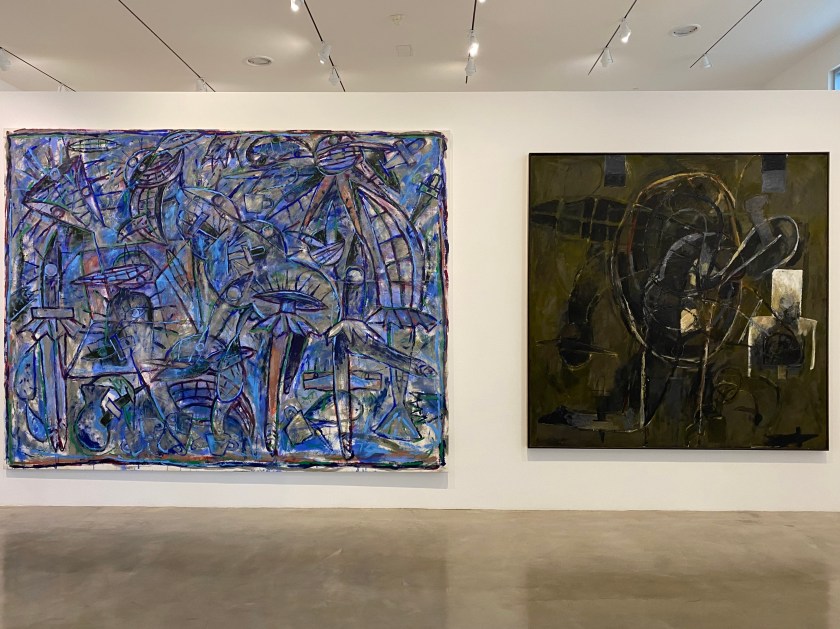
CARLOS ALFONZO
“Alfonzo has emerged over the last twenty years as one of the preeminent painters of the 1980s. In the short decade between his departure from Cuba during the Mariel boatlift of 1980 and his untimely death in 1991 from AIDS-related complications, he generated a consistent body of work that intrepidly reinvigorated expressionist painting with unexpected references to a number of cultural and semantic systems, including Cuban Santería and other religious practices. Although most of Alfonzo’s production involves highly colorful and dynamic compositions, during the last year of his life he radically reduced his color palette and engaged in a concentrated deployment of pictorial markings. The large, somber paintings of this final period pivot on a surprising range of emotional tones and sophisticated dialogue with art history. Alfonzo was born in Havana in 1950. He graduated from the Academia Nacional de Bellas Artes San Alejandro in 1973 and the University of Havana in 1977. An active participant in Cuba’s artistic community during the 1970s, Alfonzo grew increasingly disenchanted with the Revolution, frustrated by travel restrictions and pervasive homophobia. He left Cuba in 1980. As that decade went on, he began to exhibit internationally, and in 1991 participated in the Whitney Biennial and the seminal, multi-venue show “The Decade Show: Frameworks of Identity in the 1980s.” https://icamiami.org/exhibition/carlos-alfonzo/

MARK BRADFORD
“My practice is both collage and décollage at the same time. Décollage you take it away, and then collage, I immediately add it right back.” – Mark Bradford
“In the mid-2000s, Bradford expanded his focus to examine the broader economic and racial geography of the communities in which he lived. In works like Black Venus (2005) and Scorched Earth (2006), he created imaginative maps of affluent black neighborhoods. The densely textured, vibrantly colored surfaces are built up from materials salvaged from the artist’s Los Angeles neighborhood and collaged into exploded grids that recall both the vernacular abstraction of mapmaking as well as the utopian abstractions of the modernists. From similar materials, Bradford has also made a series of “merchant posters” (2006–), inspired by the advertisements hung informally around inner-city areas. In these works, layers of billboard paper overlaid on texts outlined in string have been sanded down to reveal fragments of the original phrases, and they are displayed singly or in large accumulations that recall the sites where these ads typically hang. The texts, which offer services ranging from DNA testing to expedited immigration papers, target individuals in times of personal or economic crisis and provide a window into the challenges facing urban communities.” https://www.guggenheim.org/artwork/artist/mark-bradford
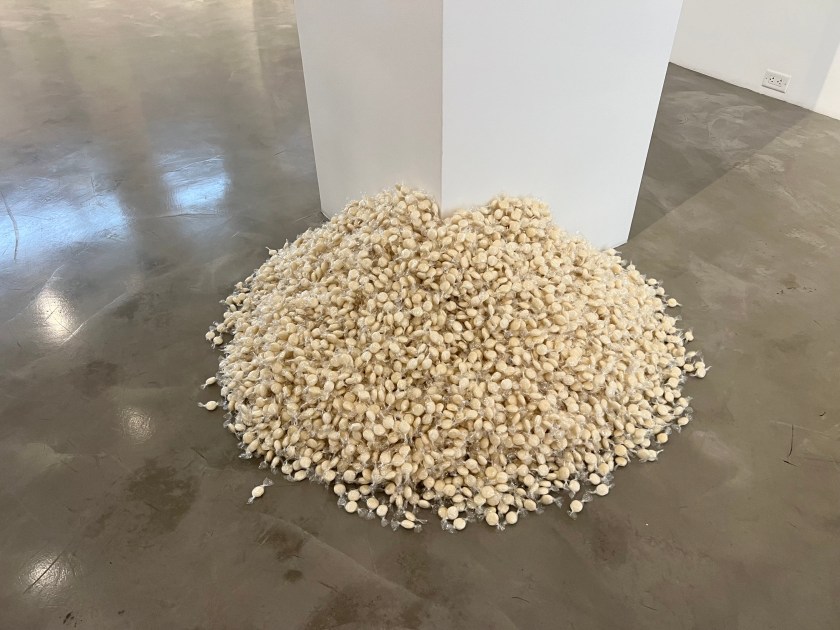
GONZALEZ-TORRES. UNTITLED (PORTRAIT OF DAD), 1991.
“You put it in your mouth and you suck on someone else’s body, and in this way my work becomes part of so many other people’s bodies. For just a few seconds, I have put something sweet in someone’s mouth, and that is very sexy.” Felix Gonzalez-Torres
This work is comprised of the favorite candy of Gonzalez-Torres’s father and, at installation, 175 lbs, the weight of his father. Visitors are free to take a piece of the candy and consume it.
“Felix Gonzalez-Torres was born in Guáimaro, Cuba, in 1957. He earned a BFA in photography from Pratt Institute in Brooklyn, New York, in 1983. Printed Matter, Inc. in New York hosted his first solo exhibition the following year. After obtaining an MFA from the International Center of Photography and New York University in 1987, he worked as an adjunct art instructor at New York University until 1989. Throughout his career, Gonzalez-Torres’s involvement in social and political causes as an openly gay man fueled his interest in the overlap of private and public life. From 1987 to 1991, he was part of Group Material, a New York-based art collective whose members worked collaboratively to initiate community education and cultural activism. His aesthetic project was, according to some scholars, related to Bertolt Brecht’s theory of epic theater, in which creative expression transforms the spectator from an inert receiver to an active, reflective observer and motivates social action. Employing simple, everyday materials (stacks of paper, puzzles, candy, strings of lights, beads) and a reduced aesthetic vocabulary reminiscent of both Minimalism and Conceptual art to address themes such as love and loss, sickness and rejuvenation, gender and sexuality, Gonzalez-Torres asked viewers to participate in establishing meaning in his works.” https://www.guggenheim.org/artwork/artist/felix-gonzalez-torres

RASHID JOHNSON
“Rashid Johnson was born in 1977 in Chicago, Illinois, and lives and works in New York. Johnson, who got his start as a photographer, works across media—including video, sculpture, painting, and installation—using a wide variety of materials to address issues of African American identity and history. Invested in the artistic practices of both conceptualism and abstraction, his influences include literary figures such as Ralph Ellison, Zora Neale Hurston, and Richard Wright as well as artists such as Norman Lewis, Sam Gilliam, and Alma Thomas. Johnson’s installations frequently include shea butter and black soap, materials that were present throughout his childhood and that carry a particular significance within Afrocentric communities.” https://art21.org/artist/rashid-johnson/
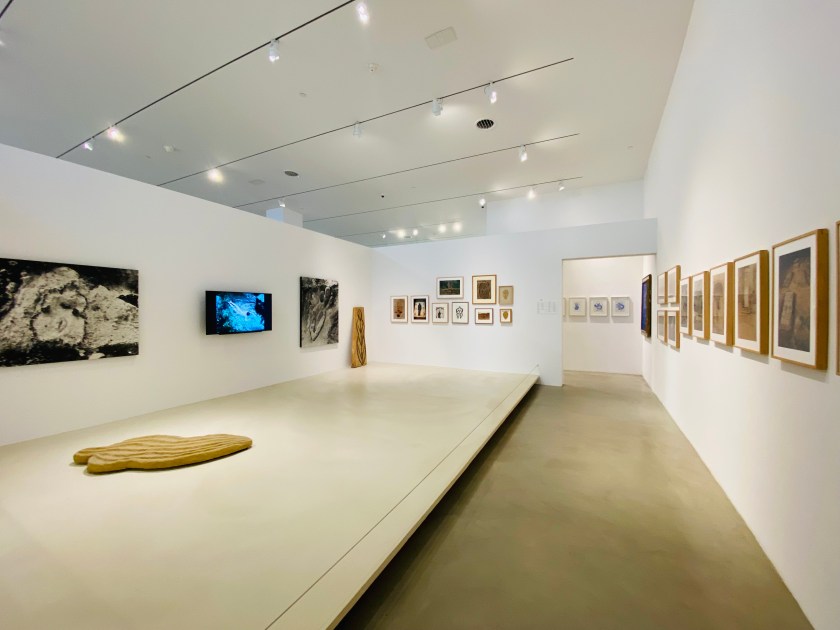
ANA MENDIETA
“I have been carrying on a dialogue between the landscape and the female body (based on my own silhouette). I believe this has been a direct result of my having been torn from my homeland (Cuba) during my adolescence. I am overwhelmed by the feeling of having been cast from the womb (nature). My art is the way I re-establish the bonds that unite me to the universe. It is a return to the maternal source. Through my earth/body sculptures I become one with the earth …. I become an extension of nature and nature becomes an extension of my body. This obsessive act of reasserting my ties with the earth is really the reactivation of primeval beliefs … [in] an omnipresent female force, the after-image of being encompassed within the womb, is a manifestation of my thirst for being.” Ana Mendieta, 1981, Unpublished Statement
“My Silueta Series is an ongoing dialogue between me and nature (1973). It is a search to find my place, my context in nature.”
“My heritage has been extremely decisive in my art. Using my body as reference in the creation of these works, I am able to transcend myself in a voluntary submersion and total identification with nature. This insistence of communion with nature has to do with reaffirming my ties with my homeland, as well as my identification with the spirits of my ancestors and my ancestors’ identification with the land itself. Through my art I want to express the immediacy of life and the eternity of nature.”
“My art is grounded in the belief of one universal energy which runs through everything: from insect to man, from man to specter, from specter to plant from plant to galaxy. My works are the irrigation veins of this universal fluid. Through them ascend the ancestral sap, the original beliefs, the primordial accumulations, the unconscious thoughts that animate the world”
“The making of these works is not the final stage of a ritual but a way of asserting my emotional ties with the earth as well as conceptualizing nature. The color photographs are a way of capturing the spirit of the work, since the actual sculptures left on sites are eventually reclaimed by the earth.”
“A Selection of Statements and Notes by Ana Mendieta”, Sulfur magazine, vol. 22, 1988.
“Ana Mendieta was born in Havana on November 18, 1948. At the age of 12, after her father joined anti-Castro counterrevolutionary forces, Mendieta was sent to the United States with her sister under Operation Pedro Pan. They spent their first weeks in refugee camps before being sent to an orphanage in Dubuque, Iowa. In 1966, the year she began studying painting at the University of Iowa, Mendieta was reunited with her mother and younger brother; her father joined them in 1979, having spent 18 years in a Cuban political prison for his involvement in the Bay of Pigs invasion.” https://www.guggenheim.org/artwork/artist/ana-mendieta
REFERENCES AND FURTHER READING
Art21
de la Cruz Collection
Guggenheim Museum

EDITORS AND LAST UPDATE
John William Bailly 12 April 2023
COPYRIGHT © ALL RIGHTS RESERVED
 Bailly Lectures