QUOTE
“This race did not seek refuge in these islands for fun, nor were those who joined later moved by chance; necessity taught them to find safety in the most unfavourable location. Later, however, this turned out to their greatest advantage and made them wise at a time when the whole northern world still lay in darkness; their increasing population and wealth were a logical consequence. Houses were crowded closer and closer together, sand and swamp transformed into solid pavement…The place of street and square and promenade was taken by water. In consequence, the Venetian was bound to develop into a new kind of creature, and that is why too, Venice can only be compared to itself.” Goethe, Italian Journey, 1786–1788
HISTORY
In approximately 40 CE, Mark stopped in the Venetian Lagoon while traveling through the Mediterranean. An angel appeared to Mark and declared, “Pax tibi, Marce, evangelista meus. Hic requiescet corpus tuum. (‘Peace be with you, Mark my evangelist. Here will be your resting place.’).” It is these words that appear repeatedly throughout Venezia, as it implies that the city was chosen by divine intervention to be the resting place of Mark. This is often shortened to “Pax Tibi Marce Evangelista Meus, which means Peace unto you, Mark, my Evangelist.”
In the 400’s 350 years after Mark’s death, the Roman Empire was beginning to crumble. Raids by Northern European people into the Italian peninsula occurred on a regular basis. This exposed previously safe villages to raids from armies and brigands. In 421, a community seeking refuge decided to live on the water. They settled not on an island, but on the lagoon itself. Miamians can image if that if Stiltsville was a village it would be similar to early Venezia.
The early Venetian settlers submerged the trunks of pine trees under the shallow water of the lagoon. Pine wood does not rot when submerged, but rather hardens to a consistency of stone. On top of these, they placed the white Istrian stone, a limestone resistant to salt water. They then built structures out of wood and bricks. Because Venice is built on the water, the city is constantly shifting an sinking. There few if any straight lines or true vertical or horizontal components. Some visitors experience a type of vertigo in Venice.
Mark died in Alexandria, Egypt on 25 April 68, which by the 800s had become a land ruled by Muslims. The Venetians decided to retrieve the body of Saint Mark and bring it to Venezia. In 828, two Venetians stole the body of Saint Mark and concealed it under porc. The muslim guards were repulsed by the porc and did not inspect the basket.
The body of Saint Mark was then buried in what was the Doge’s private chapel, now Basilica San Marco. When the Basilica was rebuilt, Saint Mark’s body was lost. It was miraculously rediscovered, an event greatly celebrated. Saint Mark’s body entering the Basilica is repeatedly depicted throughout Venezia.
BASILICA SAN MARCO
Venezia was unique in Medieval and Renaissance Europe. The city was multicultural, capitalistic, and was ruled by an elected official-the Doge (Duke). The Doge was elected by Venetian nobles and had checks on his power by different branches of government.
PALAZZO DUCALE
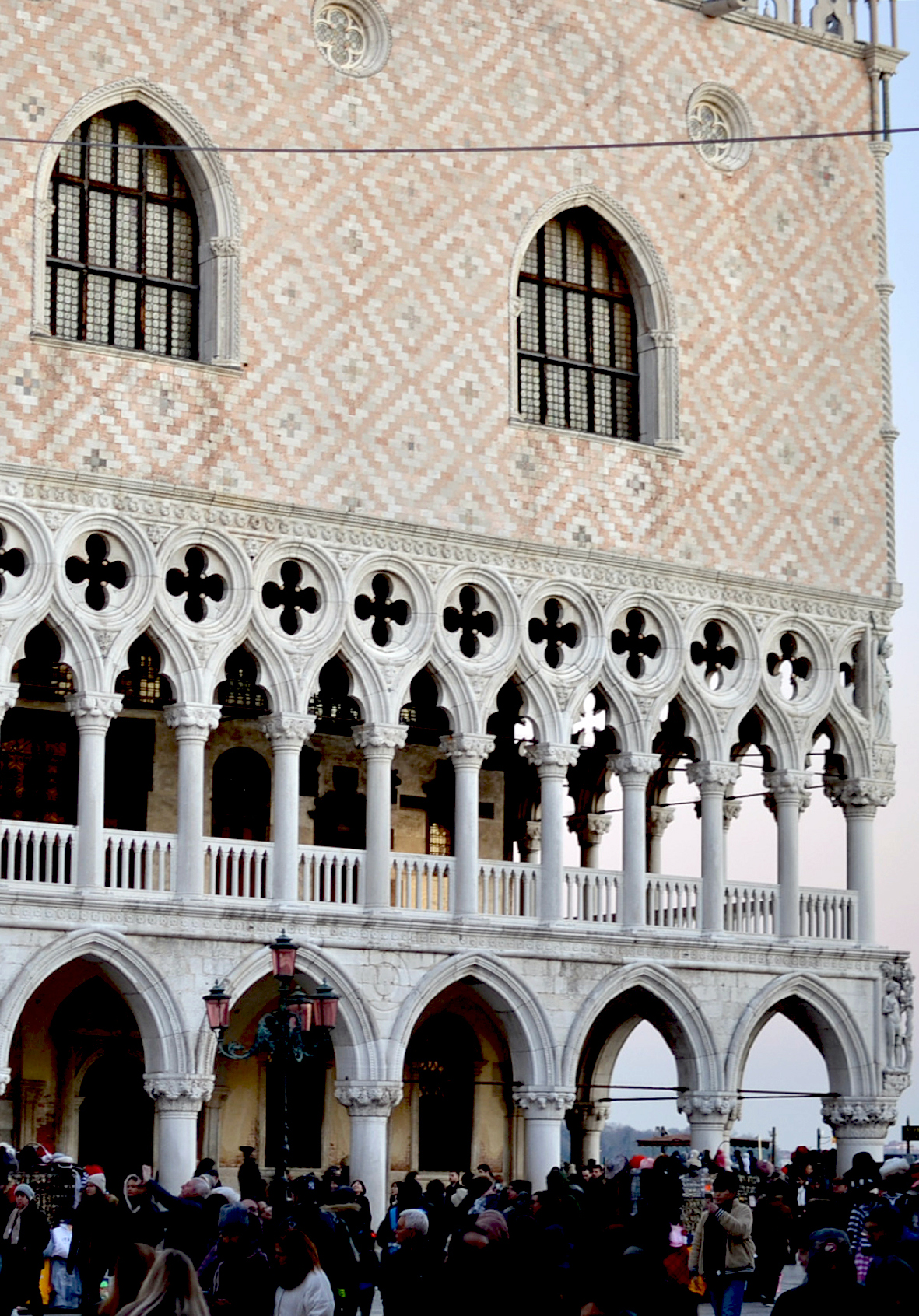
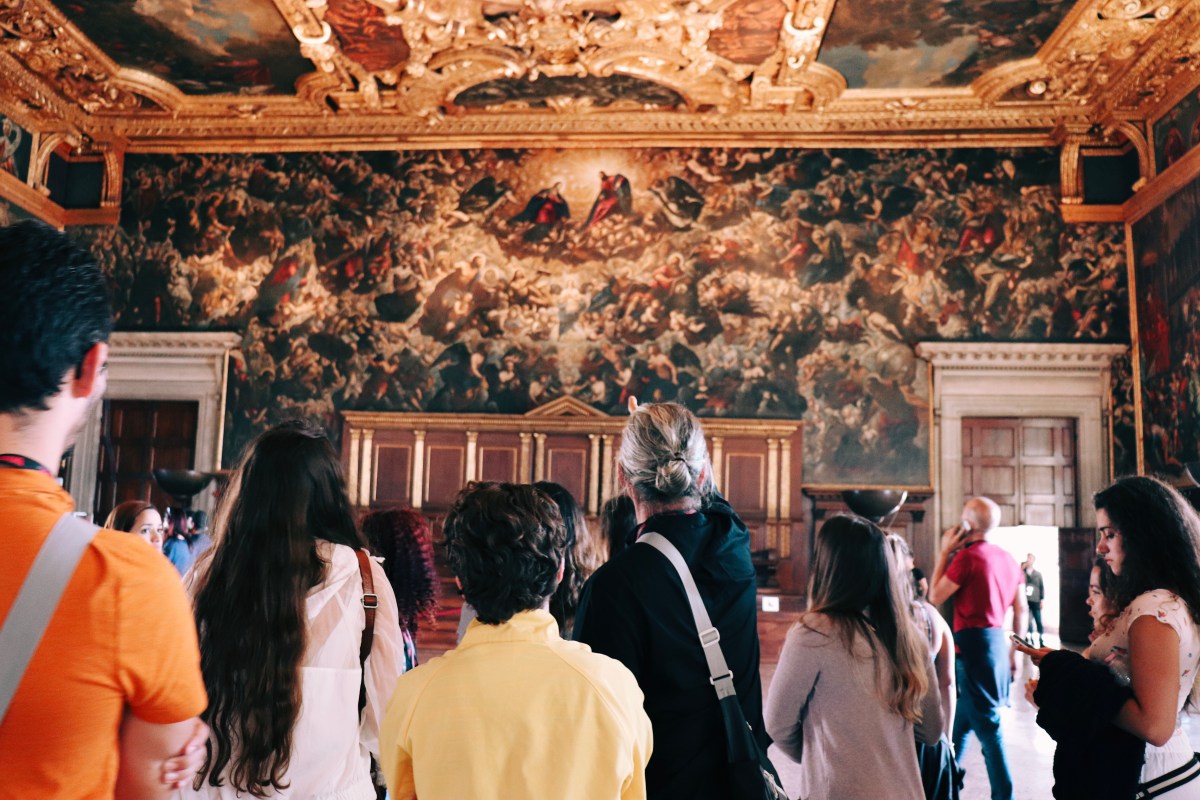
“Fourteenth-century Venice was an oligarchy, meaning that it was ruled by a select group of elite Venetian merchants. The main elected ruler was called the “doge,” and his residence was—much like the White House in the United States—a private residence and also a place for official business. Although there was already a residence for Doge Gradenigo in the 1340s, the system of government changed afterwards so that more people were involved in governmental activities. This required more space than was available in the existing palace, the great council voted to extend the palace. Workers began construction in 1340 and continued into the early part of the fifteenth century. The Palazzo Ducale sits in a prominent location. It is adjacent to the Basilica of St. Mark (Venice’s cathedral church), on St. Mark’s Square. The Ducale also overlooks the lagoon, which was a major point of entry into the city. Its prominent location made it (and continues to make it) an important symbol of Venetian architecture. It offered visitors one of their first impressions of the city. The building appears delightfully open and ornamental precisely because it is able to forego many elements of defensive architecture.” Dr. Ellen Hurst, https://smarthistory.org/palazzo-ducale/
The interest in other cultures and the exchange of ideas with those countries is best personified by Marco Polo’s account of his trip along the Silk Road to India and China in circa 1300. At that time most of Europe was closed in on itself and homogeneous. Venezia was culturally dynamic, as seen in the Islamic influence on the domes of Basilica San Marco.
“la vecia col morter,” “the old lady with the mortar.” June 15, 1310,
The Venetian Republic ultimately fell to Napoleon’s French forces in 1797. Napoleon stole artwork throughout Europe to bring back to Paris to create the largest museum in the world. When Napoleon was defeated in 1815, much of the artwork was returned to their rightful places. The Horses of San Marco are of of the most famous artworks to have undertaken this journey.
WALKING LECTURES
Macadam, Alta. Blue Guide Venice, including Murano, Burano, Torcello and all the lagoon islands plus Chioggia . Blue Guides. Kindle Edition.
EDITOR AND LAST UPDATE
John William Bailly 25 April 2022
COPYRIGHT © ALL RIGHTS RESERVED
 Bailly Lectures