
“Are we to believe that because one is an engineer, one is not preoccupied by beauty in one’s constructions, or that one does not seek to create elegance as well as solidity and durability? Is it not true that the very conditions which give strength also conform to the hidden rules of harmony? [..] there is an attraction in the colossal, and a singular delight to which ordinary theories of art are scarcely applicable.” Gustavo Eiffel
DESCRIPTION
TOUR EIFFEL LECTURE NOTES
HISTORY OF THE CHAMP DE MARS
Historians believe this is the site of the battle at which the Romans defeated the Parisii. After the Roman conquest of the Parisii in 52 BCE, Julius Caesar founded the first Roman city on Ile de la Cite. It was called Lutece. Roman rule of Paris was 300 years of peace and stability, unmatched in history of Paris.
14 July 1790. The first anniversary of the French Revolution is its most optimistic. Violence is limited, Louis XVI is still alive, and a constitutional monarchy seems possible.
1791.Two executed men. Crowd reacts to their executions. La Fayette and Bailly order the National Guard to fire on the crowd.
1889 WORLD’S FAIR
In 1889, It is the centennial of the French Revolution. Paris hosts the World’s Fair. Gustave Eiffel’s proposal, designed by engineers
Emile Nouguier and Maurice Koechlin, is selected as the major structure marking the entrance to the Fair. His proposal is a radical innovative technology. It is made with wrought iron lattice work.
Eiffel was born in Dijon in 1832. He formed his own metal construction firm in at the age of 35. His projects exists throughout the world, from Hungary to Chile (Arica Customs House). For those that have done Spain study abroad, both the Atocha train station and the Barrancos food market involve Eiffel.
“Not only the art of the modern engineer, but also the century of Industry and Science in which we are living, and for which the way was prepared by the great scientific movement of the eighteenth century and by the Revolution of 1789, to which this monument will be built as an expression of France’s gratitude.” Eiffel Proposal
“A thick cloud of tar and coal smoke seized the throat, and we were deafened by the din of metal screaming beneath the hammer. Over there they were still working on the bolts: workmen with their iron bludgeons, perched on a ledge just a few centimetres wide, took turns at striking the bolts (these in fact were the rivets). One could have taken them for blacksmiths contentedly beating out a rhythm on an anvil in some village forge, except that these smiths were not striking up and down vertically, but horizontally, and as with each blow came a shower of sparks, these black figures, appearing larger than life against the background of the open sky, looked as if they were reaping lightning bolts in the clouds.” – Journalist Emile Goudeau describes the spectacle visiting the construction site at the beginning of 1889.
An often overlooked aspect of the Tour Eiffel is that it was made to celebrate the centennial of the French Revolution. It is a monument to the Enlightenment. It lists of names of 72 scientists. The structure is taller than Notre Dame. These names were actually covered up for approximately 80 years. But their inclusion is radical. Eiffel said “the glorious crown of our country in this century in which we will celebrate the centenary of the Revolution.”
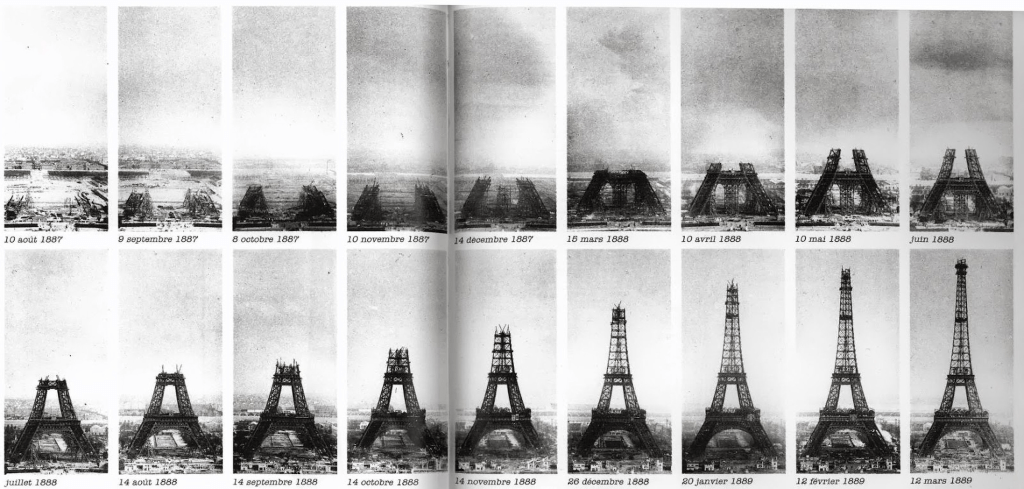
The construction work took 2 years, 2 months and 5 days. The first floor was finished on 01 April 1888. The second floor was finished on 14 August 1888. The assembly was completed with the top, on 31 March 1889. Eiffel climbed the 1700 steps to reach the highest platform.The Tour Eiffel opens on 15 May 1889. It is an instant success. 30,000 people climbed the tower in the first week.
TOUR EIFFEL BY THE NUMBERS
50 engineers and designers
5,300 workshop designs
150 workers in the Levallois-Perret factory
150-300 workers on construction site
39,000 square meters of earth were removed
18,038 different metallic components were assembled
2,500,000 rivets were used
7,300 tons of iron
10,100 tons total
60 tons of paint
Painted every seven years
1024/1083 feet original height and current height
410 feet total width (on the ground)
82 feet total pillar width (on the ground)
187 feet high, 14,485 square feet First Floor
377 feet high, 4,692 square feet Second Floor
906 feet high, 820 square feet Third Floor
5 lifts from the esplanade to second floor, 2 x 2 duolifts from second floor to the top
The tower moves as a result of wind and sun. It also expands by six inches.
It was the tallest humanmade structure in the world for 40 years.
“If you melted all the iron in the Eiffel Tower into a ball, it would be just 12 meters (less than 40 feet) in diameter. The tower’s immense height (324 meters, or over a thousand feet) belies the fact that it’s incredibly light for its size. To see it another way, if you were to melt the Eiffel Tower’s iron into a rectangular block as big as its base, then that block of iron would be only 6 centimeters (2.4 inches) tall.” Aatish Bathia https://www.wired.com/2015/03/empzeal-eiffel-tower/#:~:text=If%20you%20melted%20all%20the,incredibly%20light%20for%20its%20size.
TOUR EIFFEL CRITICS
“this truly tragic street lamp” (Léon Bloy)
“this belfry skeleton” (Paul Verlaine)
“this mast of iron gymnasium apparatus, incomplete, confused and deformed” (François Coppée)
“this giant ungainly skeleton upon a base that looks built to carry a colossal monument of Cyclops, but which just peters out into a ridiculous thin shape like a factory chimney” (Maupassant)
“a half-built factory pipe, a carcass waiting to be fleshed out with freestone or brick, a funnel-shaped grill, a hole-riddled suppository” (Joris-Karl Huysmans)”
“Now to what phenomenon did I have to give primary concern in designing the Tower? It was wind resistance. Well then! I hold that the curvature of the monument’s four outer edges, which is as mathematical calculation dictated it should be […] will give a great impression of strength and beauty [..]” Gustave Eiffel
TOUR EIFFEL IN HISTORY
Gustave Eiffel was not the main designer of the Tour Eiffel. Eiffel was the owner of the company that designed, marketed, and built the Tour Eiffel. He was a brilliant marketer and salesman.
Eiffel knew that for the Tour to last it would need to be popular and useful. He consistently emphasized its scientific and military uses.
“The most famous at the time was undoubtedly the American Thomas Edison, who gave Eiffel, on the occasion of his visit, a phonograph that could record sounds on a roll of wax.” https://www.toureiffel.paris/en/news/130-years/gustave-eiffels-social-life-tower
In WW 2, Hitler visits Paris. He can not ascend Eiffel Tower, because Parisians falsely claim elevators are broken.
REFERENCES AND FURTHER READING
Deutsch, Lorant. Métronome : L’histoire de France au rythme du métro parisien. Michel Lafon, 2014.
Gray-Durant, Delia. Blue Guide Paris . Blue Guides, 2015.
Horne, Alistair. Seven Ages of Paris . Knopf Doubleday Publishing Group, 2004.
King, Ross. The Judgment of Paris. Bloomsbury Publishing, 2006.
Norwich, John Julius. A History of France. Grove Atlantic, 2018.
Price, Roger. A Concise History of France (Cambridge Concise Histories). Cambridge University Press, 2014.
Steves, Rick; Smith, Steve; Openshaw, Gene. Rick Steves’ Paris 2014 . Avalon Travel, 2014
Tour Eiffel. https://www.toureiffel.paris/en
UNESCO World Heritage Foundation. whc.unesco.org/

EDITOR AND LAST UPDATE
John William Bailly 30 June 2023
COPYRIGHT © ALL RIGHTS RESERVED
 Bailly Lectures