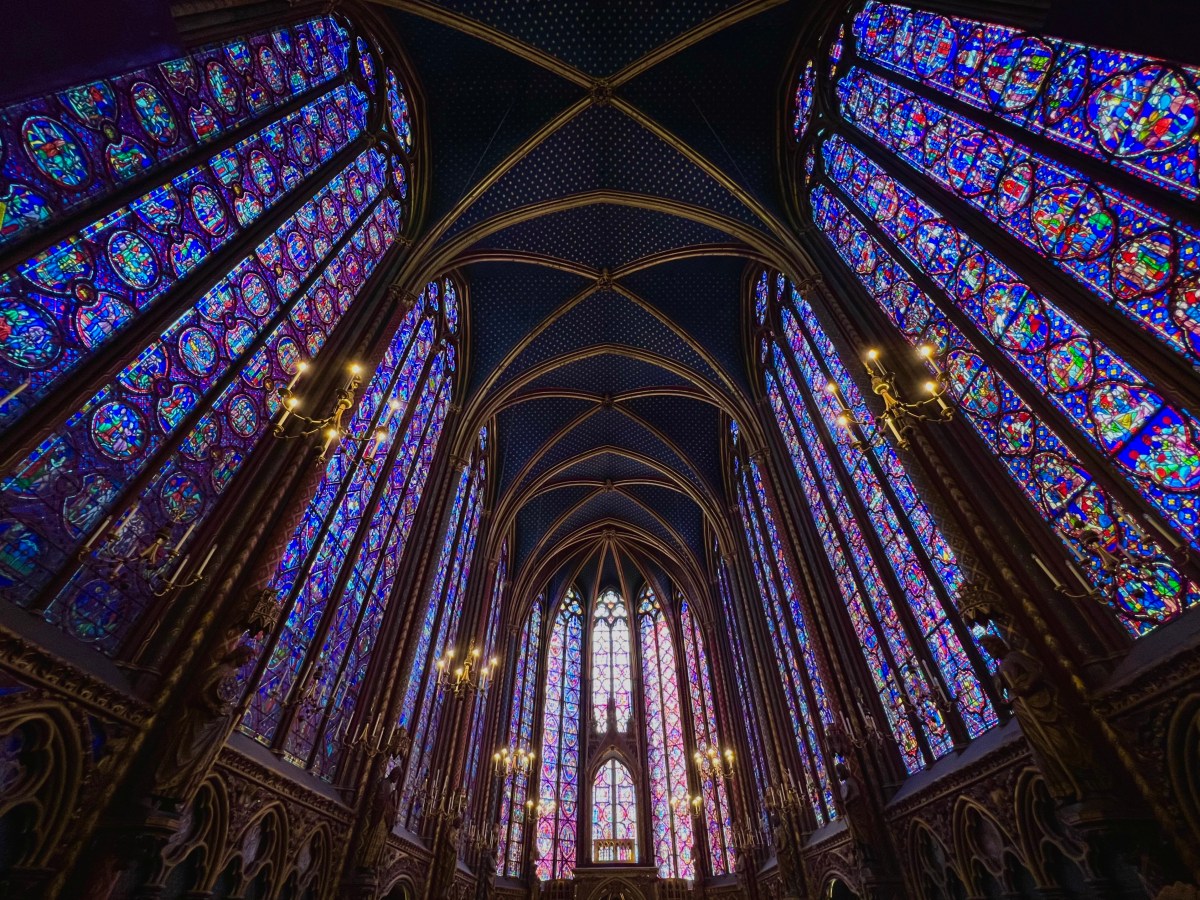
“On any street you could buy a baguette, a pair of underpants taille grand patron, or beer or brandy or coffee or charcuterie. Ravelstein was an atheist, but there was no reason why an atheist should not be influenced by the Sainte-Chapelle, should not read Pascal. For a civilized man there was no background, no atmosphere like the Parisian.” Saul Bellow
DESCRIPTION
“The Sainte-Chapelle is a personal commission of King Louis IX, future Saint Louis, a private chapel in the heart of his apartments in the Palais de la Cité, the first residence of the kings of France in Paris.” https://www.sainte-chapelle.fr/en/discover/a-unique-set-of-stained-glass-windows
SAINTE-CHAPELLE LECTURE NOTES
Louis IX seeked to legitimize his divine right to rule. He purchased the true crown of thorns and part of the holy cross from the Emperor of Constantinople. In 1238 he ordered the Sainte Chapelle to be built to serve as Royal Chapel and to present the holy relics. Sainte-Chapelle was consecrated in 1248, after only seven years. Possessing the most holy relics made Louis IX the most divine/powerful king in Europe.
The Crown of Thorns cost more than the building itself.
Cost of Sainte-Chapelle: 40,000 livres
Cost of Chest to store the relics: 100,000 livres
Cost of Crown of Thorns: 135,000 livres (half of the income of the Kingdom)
Louis IX is the only French king to be a saint.
“Precious vestige of the royal palace of the Palais Royale of Paris, The Sainte-Chapelle was built in the middle of the 1200s by Louis IX, future Saint Louis, to house the most prestigious relic of the Passion of Christ: the Crown of Thorns and a fragment of the True Cross. Built in less than 7 years, a record time, the Sainte-Chapelle was conceived as a piece of goldsmith’s art, whose walls of light exalt the Capetian monarchy and the kingdom of France.” https://www.sainte-chapelle.fr/en/discover/history-of-the-sainte-chapelle
The Sainte-Chapelle is one of the finest examples of Rayonnant Gothic architecture and one of the greatest achievements of stained glass. Its relatively small scale enables visitors to experience stained glass up close. The movement is vertical, due to the fact that structure itself is really only a skeleton for the stained glass.
“The Sainte-Chapelle is probably one of the paradigms of this will which animates the builders to make the wall disappear: the pillars form a stone skeleton, the rest being of glass, letting an abundant light penetrate in order to establish in the religious buildings a feeling of immateriality and lightness through the more and more preponderant use of the stained glass.”
In Revelations 21:8 the New Jerusalem of the Last Judgement appears as a city of precious stones and clear glass “And the building of the wall of it was of jasper: and the city was pure gold, like unto clear glass.”
The Chapel Base was reserved to servants and attendants. It is decorated with the fleurs de lys for Louis IX and the towers of Castille for Blanche de Castille (Louis IX’s mother). The Annunciation mural is the oldest in Paris. The 12 sculptures are the 12 apostles.
In the upper level, there is an oratory for Louis IX and one for Blanche de Castille, his mother. This section was reserved for the King and his family and guests.
There are 15 stained glass windows, containing 1,113 scenes. They depict Biblical history from the Old Testament until the entry of the relics into Paris. It is the entire history of world from a Catholic perspective.
- Genesis
- Exodus
- Numbers
- Deuteronomy & Joshua
- Judges
- Isaiah & Tree of Jesse
- St. John the Evangelist & The childhood of Christ
- The Passion
- Life of St. John the Baptist & Daniel
- Ezekiel
- Jeremiah & Tobias
- Judith & Job
- Esther
- Kings
- Story of the Relics of the Passion
- Revelations
When standing at the entrance doors of the Sainte-Chapelle, “1. Genesis” is the first on your left.
1. Genesis: God creating round Earth, Adam and Eve, Original Sin, Expulsion from Eden, Cain and Abel, Noah’s Flood
2. Exodus: Baby Moses in blanket, Moses found by Pharaoh’s daughter, God appearing in the burning bush with ten commandments
3. The Book of Numbers:Kings of Israel crowned-linked to Louis IX. Look at all fleurs de lys
4. The Book of Joshua: Siege of Jericho, Soldiers depicted with horns
5. The Book of Judges: Delilah cutting the hair of Samson,
6. The Book of Isaiah and the Tree of Jesse: Condemnation of idolatry. From Jesse will come Christ.
7. The life of St John the Evangelist and the Childhood of Christ: Annunciation, Nativity, Adoration of the Magi, Flight to Egypt
8. The Passion (central window). This is considered the most outstanding of all the windows. It shows the Passion directly behind where the Crown was kept. Crown of Thorns, Flagellation
9. Stories of John the Baptist and the Book of Daniel: Baptism of Christ, Dance of Salome, Death of John the Baptist, Daniel in prison
10. The Book of Ezekiel: (92 of the 121 scenes are original), destruction of Jerusalem, Worship of idols with God turning away
11. The books of Jeremiah and Tobias: Worship of idols
12. The books of Judith and Job: Judith and Holofrenes, Invasion of Israel, Judith bathing, Judith beheading Holofrenes. Job getting hair cut, Demon causing Job’s house to collapse
13. The Book of Esther: Virtue and strength of women, reflecting greatness of Blanche, Execution by hanging
14. The Book of Kings: David model king for medieval kings. David and Goliath. He is a man.
15. The legend of the True Cross with illustrations of the translation of the Relics to Paris by St Louis. However, this contains only 26 of the original 67 scenes (which read in a serpentine sequence), Louis barefooted. “A medallion in the bay of relics shows us, if there were any doubt, the piety of the king. Louis IX is represented, accompanied by his brother, Robert d’Artois, barefoot, carrying on his shoulders a stretcher covered with a veil under which the Holy Crown is kept. The representation of the king participating in a contemporary event, at the origin of the construction of the Sainte-Chapelle, makes the iconography of this stained glass interesting. The King is represented as a distant successor of the first kings of the Old Testament: Saul, Solomon and David, a spiritual guide leading his people to divine revelation and ensuring their salvation.” https://www.sainte-chapelle.fr/en/discover/the-bay-of-the-relics-of-the-sainte-chapelle
16. Rose window (west end). The 86 panels from the Apocalypse, which are the easiest to read of all the windows, were a gift from Charles VIII (15th century). Christ with sword of judgment in his mouth. End of times meets Genesis.
REFERENCES AND FURTHER READING
Deutsch, Lorant. Métronome : L’histoire de France au rythme du métro parisien. Michel Lafon, 2014.
Gray-Durant, Delia. Blue Guide Paris . Blue Guides, 2015.
Horne, Alistair. Seven Ages of Paris . Knopf Doubleday Publishing Group, 2004.
King, Ross. The Judgment of Paris. Bloomsbury Publishing, 2006.
Norwich, John Julius. A History of France. Grove Atlantic, 2018.
Price, Roger. A Concise History of France (Cambridge Concise Histories). Cambridge University Press, 2014.
Sainte-Chapelle official website. https://www.sainte-chapelle.fr/en
Steves, Rick; Smith, Steve; Openshaw, Gene. Rick Steves’ Paris 2014 . Avalon Travel, 2014
UNESCO World Heritage Foundation. whc.unesco.org/

EDITOR AND LAST UPDATE
John William Bailly 30 June 2022
COPYRIGHT © ALL RIGHTS RESERVED
 Bailly Lectures