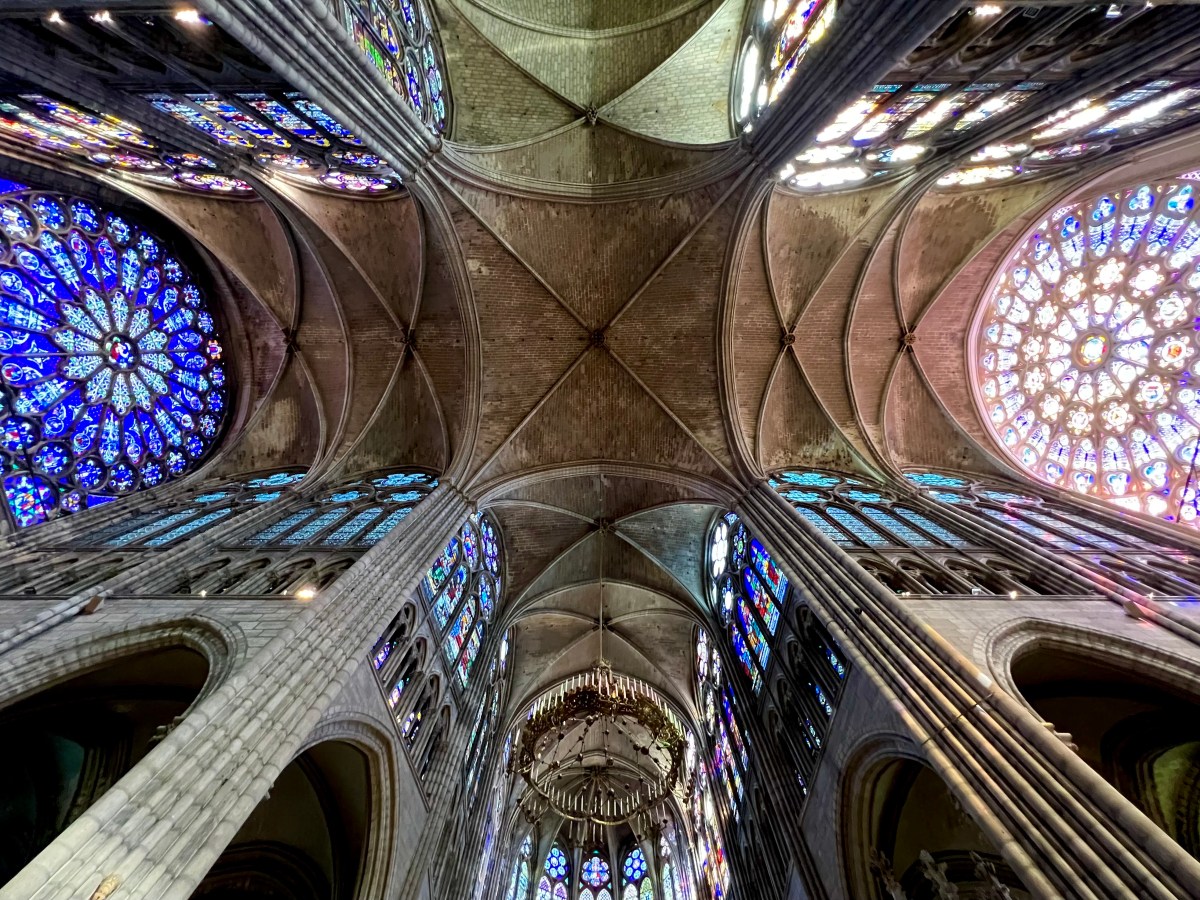
DESCRIPTION
“For centuries, the Saint-Denis royal abbey illuminated the artistic, political and spiritual history of the Frankish world. The abbey church was designated a basilica in Merovingian times. Starting in the 4th century, the word basilica was applied to churches whose floor plans were the same as those of Roman civic buildings used for trade and the administration of justice. Often erected outside cities and over the tomb of a saint, basilicas frequently led to the development of neighbourhoods or market towns, such as the city of Saint-Denis, which was built around the abbey and its economic potential. The church stands on the site of a Gallo-Roman cemetery, the resting place of Saint Denis, who was martyred around 250. In addition to a Carolingian crypt, part of the building consecrated by Charlemagne in 775, it retains vestiges of two structures that played a pivotal role in the development of religious architecture: Suger’s chevet, a veritable hymn to light and the manifesto of the nascent Gothic art; and the part that was rebuilt in Saint Louis’ time, whose vast transept was designed to house royal tombs. A place of memory, in the Middle Ages the Saint-Denis monastery linked its destiny to that of royalty, gradually asserting itself as the preferred resting place of royal dynasties, helped by the cult of Saint Denis. Forty-two kings, 32 queens, 63 princes and princesses and 10 nobles were laid to rest there. With over 70 recumbent figures and monumental tombs, the basilica’s royal necropolis constitutes the most important collection of funerary sculptures from the 12th to the 16th centuries. Throughout history, sovereigns have sought legitimacy, which explains in part why they wanted to be laid to rest near Saint Denis’ relics. The king believed that, through the power of the holy martyr, he would gain power and protection during his lifetime, especially in battle, as well as direct access to Paradise.” https://uk.tourisme93.com/basilica/saint-denis-abbey.html
BASILIQUE CATHÉDRALE DE SAINT-DENIS LECTURE NOTES
CATHERINE DE MEDICI AND HENRI II
“The tomb of Henry II and Catherine de’ Medici, constructed between 1560 and 1573 and positioned at the very centre of the rotunda, is now to be found inside the Basilica. The greatest artists of the Renaissance worked on the project including Primatrice, the Italian sculptor Ponce Jacquio and the Frenchman Germain Pilon. The monumental construction is enlivened by marble in various colours, a practice inspired directly from the new spirit emanating from Italy. What hold the most attention are the monumental bronze Virtues at the four corners of the tomb, a striking example of the mannerist style in art.
Once the sculptors’ work was finished, Catherine de’ Medici judged her fixation to be too macabre and emaciated. She refused to accept it and commissioned a second one, which can be seen in Saint-Denis. The first one was presented to the Louvre and contrasts sharply with the version in Saint-Denis, which depicts the queen in a gentle sleep and is said to have taken its inspiration from a Venus in the Uffizi in Florence.” https://uk.tourisme93.com/basilica/tomb-of-henri-and-catherine-de-medici.html
CHARLES V AND JEANNE DE BOURBON
Charles V, king of France from 1364 to 1380, and his wife Jeanne de Bourbon. King of the Valois dynasty. Charles V and his wife Jeanne de Bourbon, the first statue of a French king taken from life. White marble. At the age of 27, king Charles V (known as the Wise and a great patron of the arts) commissioned his funerary statue from André Beauneveu, one of the most celebrated sculptors of the age. This is doubtless the first official portrait in the history of funerary statuary and is one of the finest masterpieces of medieval sculpture. https://uk.tourisme93.com/basilica/charles-v-and-jeanne-de-bourbon.html
DAGOBERT
“Dagobert is the first king buried in the Basilica in 639. He is considered to be the abbey’s founder. The monks paid him homage in the XIIIth century by fashioning a tomb of remarkable dimensions now in its original position in the sanctuary. His funerary statue, lying on its left side, looks towards the location of the early tomb of St Denis. Three carvings on the tomb tell the story of the vision of the hermit John. The king’s soul, depicted as a naked child wearing a crown, is carried off to Hell on account of his regrettable practice of disposing of the property of certain churches. But in the upper panel, St Denis, St Martin and St Maurice seize the soul from the hands of the demons and take it off to Heaven where it is granted entry to Paradise. This vision expresses Saint Denis’ and the abbey’s role as protector of the Capetian monarchy.” https://uk.tourisme93.com/basilica/tomb-of-dagobert.html
FRANÇOIS I AND CLAUDE DE FRANCE
“The tomb of Francis I, his wife Claude de France and three of their children was built in 1558, around ten years after the king’s death. The desire of Henry II, the son of the deceased king and the one who commissioned the tomb, was to ensure the memory of the knight-king and chief of the armed forces by offering praise for the famous F, where he was victorious at the age of 20. What is striking is the supreme documentary precision in the bas-relief tracing the 1515 battle, which took place near Milan. It details several episodes: the preparations, the crossing of the Alps and the confrontation of the two armies. At the head of the French army and German mercenaries, Francis I as a knight on horseback, recognizable by the monogram F on the saddle of his horse, at his side Baillard the knight facing a coalition made up of Italians, the pope’s troops and Swiss forces.” https://uk.tourisme93.com/basilica/the-tomb-of-francois.html
HEART OF LOUIS XVII
“The ritual burial of the heart of Louis XVII was organised by the Mémorial de France in Saint-Denis during a funeral mass on June 8, 2004. The heart is said to have been secretly removed by the chief surgeon at the Hôtel-Dieu, Philippe-Jean Pelletan, the day after the child’s death. Placed in a crystal vase it was preserved and then dried out because the alcohol in which it was immersed had evaporated. It was passed from hand to hand and has been in the Basilica since 1975. During the June 8, 2004 ceremony it was placed under the medallion bearing a portrait of the young king.” https://uk.tourisme93.com/basilica/louis-xvii-heart.html
ISABELLA DE ARAGON
“Isabelle d’Aragon, daughter-in-law of Saint-Louis, wife of Philip III (the Bold). Died prematurely in 1271. Isabelle died while crossing a ford during her return journey from a crusade, while she was pregnant. This tomb from the late 13th century was the beginning of a style which was to last throughout the 14th century. Her tomb is realistic in its depiction of the flowing folds of her clothing. The white marble, formerly highlighted in different colours, is on a black marble plinth on which is carved a rhyming epitaph in French. The monument is the only one that was left intact during the Revolution, thanks to its fine non-religious inscription.” https://uk.tourisme93.com/basilica/isabelle-d-aragon.html
LOUIS XII AND ANNE DE BRETAGNE
“The mausoleum of Louis XII and Anne of Brittany was carved in Carrara marble by Italian sculptors. It is evidence of the contacts that were established between artists during the Italian wars. This small antique-style temple is surrounded by the twelve Apostles and the four cardinal virtues, Prudence, Might, Justice and Temperance and the plinth is decorated with bas-reliefs depicting several victorious episodes of the Italian wars. Inside the mausoleum, the royal couple are portrayed transfixed and motionless in death. On their abdomens are depicted, for the sake of realism, the sewn-up openings made for the purposes of evisceration. On the upper level the kneeling sovereigns pray for the life to come. This double image of the sovereigns’ bodies is intended to be, for Christians, an invitation to meditate on death and the Resurrection.” https://uk.tourisme93.com/basilica/tomb-of-louis-xii-and-anne-de-bretagne.html
SAINT-DENIS
“However, the true story of Saint-Denis began with Denis, evangelizer of the Parisii, described by Grégoire de Tours as one of the seven missionary bishops of Gaule ; towards 250, he was said to have suffered martyrdom in Paris during perscution of the christians. An empty tomb, still visible in the heart of the archaelogical crypt, corresponds to the Saint’s grave. In the cemetery of the 4th century which grew up around this burial place, the bodies were laid in wooden coffins or stone sarcophagus many of which were used as coverplates for roman wall-coverings. One of these tombs contained a cruciform fibula charateristic of the apparel of dignitaries at the end of gallo-roman Antiquity. In a place close to the cemetary a workshop produced bone pins.” https://uk.tourisme93.com/basilica/the-archaeological-crypt.html

REFERENCES AND FURTHER READING
Deutsch, Lorant. Métronome : L’histoire de France au rythme du métro parisien. Michel Lafon, 2014.
Gray-Durant, Delia. Blue Guide Paris . Blue Guides, 2015.
Horne, Alistair. Seven Ages of Paris . Knopf Doubleday Publishing Group, 2004.
King, Ross. The Judgment of Paris. Bloomsbury Publishing, 2006.
Norwich, John Julius. A History of France. Grove Atlantic, 2018.
Price, Roger. A Concise History of France (Cambridge Concise Histories). Cambridge University Press, 2014.
Seine-Saint-Denis Tourisme. https://uk.tourisme93.com/
Steves, Rick; Smith, Steve; Openshaw, Gene. Rick Steves’ Paris 2014 . Avalon Travel, 2014
UNESCO World Heritage Foundation. whc.unesco.org/
EDITOR AND LAST UPDATE
John William Bailly 30 June 2023
COPYRIGHT © ALL RIGHTS RESERVED
 Bailly Lectures