“I happened to be in winter quarters at my beloved Lutetia, for that is how the Celts call the capital of the Parisians. It is a small island lying in the river; a wall entirely surrounds it, and wooden bridges lead to it on both sides. The river seldom rises and falls, but usually is the same depth in the winter as in the summer season, and it provides water which is very clear to the eye and very pleasant for one who wishes to drink. For since the inhabitants live on an island they have to draw their water chiefly from the river.” Emperor Julian in “The Misopogon,” 363
HISTORY
“The first people to establish a permanent base here (in Paris), probably in the 4th century BC, were a Celtic tribe later called (by the Romans) Parisii. They established themselves on what is now the Île de la Cité, the biggest of what were then a dozen islands, in a river probably twice as wide then as now. They were semi-nomadic, trading up and down the river, leaving no trace of grand buildings or paved streets, and with no bridges to connect their settlement to the banks. They worshipped the water: a fact worth recalling when one sees modern Paris’ coat of arms (of a ship afloat) and motto (fluctuat nec mergitur: she is tossed on the waves but not engulfed).” Delia Gray-Durant
When Julius Caesar embarked on his conquest of Gaul in 58 BCE, he encountered primarily a nomadic people without a union between villages. The organization and strategy of the Romans overcame the more numerous yet disorganized Gauls. Vercingetorix, a greatest Gallic general, attempted in vain to coordinate a unified Gaul. Vercingetorix surrendered after the historic battle of Alesia and was eventually executed in Rome.
In 52 BCE, the Romans defeated a combination of Gallic tribes, including the Parisi, near what is today the Champ de Mars. The Roman victory transformed the urban design, agriculture, and trade of Lutetia (Paris). A considerable amount of the structure of contemporary Paris can be traced back to Roman Lutetia.
The fall of the Roman Empire and the rise of Christianity is embodied in the life and death of Saint-Denis.
“By the end of the first century A.D., Christianity had arrived in Paris, followed shortly thereafter by the first martyrs. Dionysius, or Denis, came from Rome and was probably Greek. Aged ninety, he was arrested for denying the divinity of the Emperor, imprisoned on what is now the Quai aux Fleurs, close to the modern Préfecture de Police, and then dragged up the Roman highway that still bears his name northwards from the Seine. On top of a hill overlooking the city where stood a temple to Mercury, he and two supporters were decapitated. According to legend, he picked up his head with its long white beard, washed it in a nearby stream, and continued walking for “six thousand paces.” The spot where he finally dropped and was buried became a holy place. Eventually the cathedral of Saint-Denis was built on its site, subsequently to become the burial place of French kings from Dagobert onwards. His place of execution became the “Mons Martyrum”—or Montmartre; and the city annals chalked up their first revolutionary martyr as well as their first bishop.” Alistair Horne
In the 400s, the fall of the Roman Empire led to a period of cultural and social turmoil in Paris. The city was attacked and plundered by various peoples, including the Visigoths and the Huns. However, in the 6th century, the Frankish king Clovis I established Paris as the capital of the Merovingian dynasty, marking the beginning of the city’s prominence in the medieval period. Clovis I conversion to Christianity in 496 marks the start of a rule by Christian kings for approximately 1300 years.
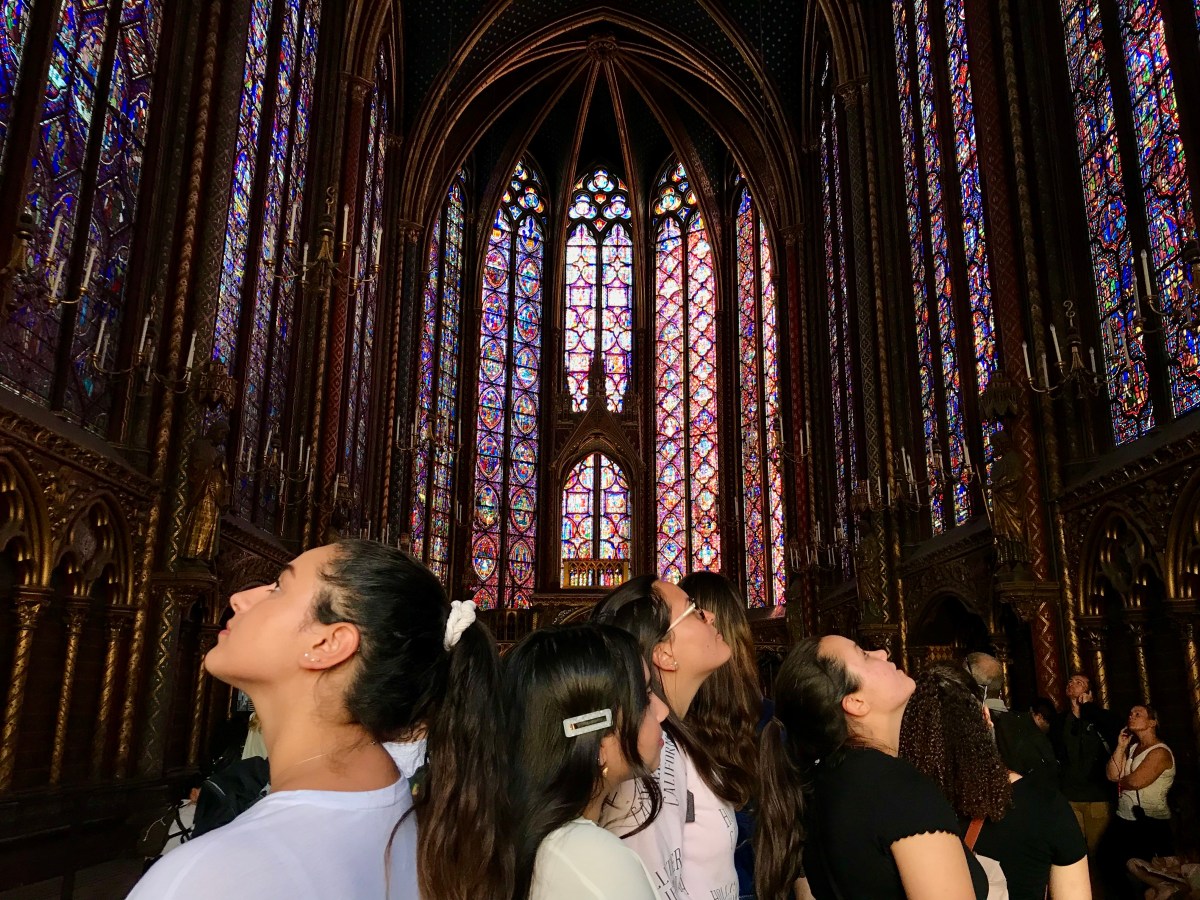
The medieval era saw Paris emerge as a center of learning and culture. In the 1100s and 1200s, Paris became a leading city of learning, culture, religion, and trade, especially under the reign of Louis IX. These two centuries saw the birth of the Gothic with the construction of Sainte-Chapelle, Basilique Saint-Denis and Cathédrale Notre-Dame de Paris. Politically these centuries were defined by the Seventh and Eighth Crusades led by Louis IX. Paris also became a hub for trade, attracting merchants and artisans from across Europe. The University of Paris became a renowned center of learning, producing scholars such as Thomas Aquinas and giving birth to the Latin Quarter (because everyone studied Latin and many communicated in Latin).
Louis XIV was perhaps the most transformative figure in French history. Louis XIV moved the French Court out of Paris to Versailles, and gave birth to the first genuine French cultural manifestation, the Rococo. Louis XIV simultaneously developed parts of the infrastructure of France and grossly neglected large swaths of the French by over-centralizing and detaching government from the people of France. Louis XIV made France great, while also laying the seeds of the destruction of its monarchy.
REFERENCES AND FURTHER READING
Deutsch, Lorant. Métronome : L’histoire de France au rythme du métro parisien. Michel Lafon, 2014.
Gray-Durant, Delia. Blue Guide Paris . Blue Guides, 2015.
Horne, Alistair. Seven Ages of Paris . Knopf Doubleday Publishing Group, 2004.
King, Ross. The Judgment of Paris. Bloomsbury Publishing, 2006.
Norwich, John Julius. A History of France. Grove Atlantic, 2018.
Price, Roger. A Concise History of France (Cambridge Concise Histories). Cambridge University Press, 2014.
Steves, Rick; Smith, Steve; Openshaw, Gene. Rick Steves’ Paris 2014 . Avalon Travel, 2014
UNESCO World Heritage Foundation

EDITOR AND LAST UPDATE
John William Bailly 01 July 2023
COPYRIGHT © ALL RIGHTS RESERVED
 Bailly Lectures