DESCRIPTION
HISTORY
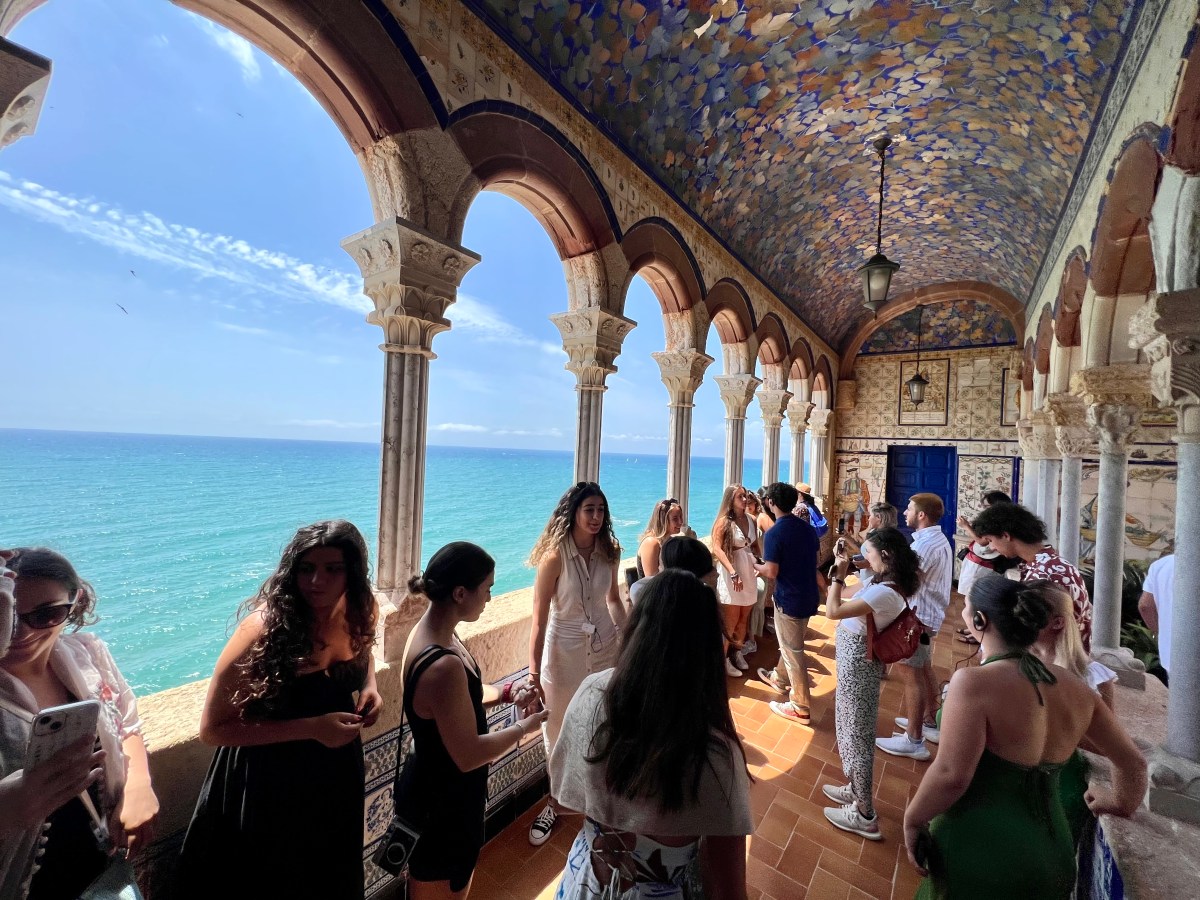
Sitges became a cultural center of Modernisme and unexpectedly had a direct and lasting impact on the culture of Miami.
Santiago Rusiñol, one of the founders of the Four Cats cafe in Barcelona, purchased a large home in Sitges. He called his home Cau Ferrat, the Den of Iron, in homage to his admiration for Spanish wrought iron work. The painter Ramon Casas joined him, as did Miquel Utrillo. Rusiñol transformed his home in to a museum, with notably two works by El Greco and a collection of iron works. Rusiñol also purchased five works by Pablo Picasso, after Picasso’s exhibition in the Four Cats.
“Setting out with a friend to visit the museum created by the writer Victor Balaguer in the town of Geltru, he made a detour to spend the night in the fishing village of Sitges, some twenty-five miles south of Barcelona; he fell in love with the place and bought two adjacent houses there. They stood on a low cliff at the face of the town, an easy stroll from the beach where fishermen drew up their boats; their windows looked straight onto the sea below. This, Rusinyol decided, would be his refuge; and he would transform it into a cultural center, a private museum, a place to show old Catalan crafts—particularly forged ironwork, which he adored—and new manifestations of modernisme in painting, music, theater, and poetry. He spent the considerable sum of thirty thousand pesetas doing it up in an eclectic mixture of styles (Neo-Gothic with Moorish overtones) with the help of the young architect Francesc Rogent, son of Elias, the architect of the exposition. He named it the Cau Ferrat, or Den of Iron. Thus the center of gravity of modernisme moved, with Rusinyol and his friends, to Sitges.” Robert Hughes
Rusiñol hosted many visitors including Manuel de Falla. De Falla actually finished writing his famous Nights in Garden of Spain on the piano preserved in Cau Ferrat. The garden that inspired de Falla was the Generalife of the Alhambra in Granada.
In Paris, the Catalan artists, befriended two brothers from the United States. One of the brothers purchased a home near Rusiñol’s in Sitges, as well as the town old hospital. This new resident to Sitges was Charles Deering. Deering’s home was called Maricel, the crest of which is the sun over the sea.
The time of harmony between Charles Deering and the Catalan artists was disrupted by World War I. At this time, travel to Europe was dangerous from the United States and Deering turned his attention elsewhere-Miami!
In 1916, Charles Deering began construction of the Stone House at what is now the present day Deering Estate. The Stone House is directly inspired by the Maricel Palace. The Official Museu Siges website describes the history
“The history of the museums of Sitges is closely linked to collecting art since its inception and well as before the opening of its first public museum, the Museum of Cau Ferrat (1933). Both the art collection that the painter and writer Santiago Rusiñol started very young, being a disciple of the painter Tomàs Moragas, in which initially forged predominates wrought iron and antiques, as the collection from the American industrialist, philanthropist and collector Charles Deering assembled by Miquel Utrillo in parallel with the construction of Maricel Palace (1910-1921) are the result of determination and perseverance in order to configure collections to enjoy and admire. What had been the home workshop of Santiago Rusiñol during the nineties of the nineteenth century and the museum-workshop, is finally bequeathed to Sitges due to the love he professed for this population, as we read literally in his will at the artist’s death (1931). In 1933, the museum became public thanks to the director of the Museum of Art of Catalonia, Joaquim Folch i Torres. From that date, the Cau Ferrat Museum is the dean of all museums of Sitges. With the collection of Charles Deering it is just the opposite. In 1921, due to disagreements with Miquel Utrillo, he takes his art collections out of Maricel. The halls of his homes and the Palace became empty, showing empty walls, ceilings and roofs in an artistic and sumptuous complex artistic with a high artistic and architectural value, one of the most illustrious exponents of “Noucentista” architecture, as had been recognized from early construction.” https://museusdesitges.cat/en/museum/maricel/history
It is known that James Deering also visited Sitges. While the artistic and intellectual circles of Sitges must have captured Charles, it was most likely the fiestas modernistas that captivated James.
“Quite a number…made the journey to Sitges to take part in the festes modernistes, or “modernist festivals,” that Rusinyol organized there from 1892 until 1899; they generated so much interest that special trains were arranged to bring the participants from Barcelona…The star of the 1894 festa modernista was El Greco. From a Paris banker Rusinyol had bought, with the help of the Spanish expatriate painter Ignacio de Zuloaga, two El Grecos, a Mary Magdalene and a Saint Peter (they still hang in the Cau Ferrat), and he turned their installation into a ceremony, a reenactment of the processions of medieval homage he had read about in Vasari—the reverent portage of a Cimabue altarpiece through Florence or of Duccio’s Maestà through Siena. El Greco’s morbid mannerist figures in their contrapposto poses, with their pallor and ecstatic spirituality, qualified him as a forefather of symbolism; he therefore deserved the fullest homage. On November 14, 1894, ne got it. Down came the train from Barcelona, carrying the two Grecos and a load of writers, painters, architects, journalists, and other local celebrities—more than sixty of them, including Casas, Joan Maragall, and the man reputed to be the worst social snob in the Eixample (a large claim in the 1890s), J. A. Riera. It was met at the station by Pere Romeu, the future manager of the café Els Quatre Gats, looking like some deranged Quixote on horseback, with an illustrator named Lluís Labarta as his Sancho Panza on foot, carrying the banner of the Cau Ferrat. Each Greco was hoisted up on a bier, carried by four artists, and the procession led by Romeu solemnly marched up the hill to deposit the paintings in the Cau Ferrat before traipsing off to a monumental lunch. For years thereafter, the people of Sitges were convinced that El Greco was a relative, an obscure cousin perhaps, of Senyor “Tiago” Rusinyol.” Robert Hughes
SITGES LECTURE NOTES
REFERENCES AND FURTHER READING
Ajuntament de Barcelona https://www.barcelona.cat/en/
Barcelona Modernisme Route https://rutadelmodernisme.com/en/
Barcelona Turisme www.barcelonaturisme.com/wv3/en/
Hughes, Robert. Barcelona . Knopf Doubleday Publishing Group. 1992.
Palau de la Música https://www.palaumusica.cat/en
Phillips, Jr, William D.; Rahn Phillips, Carla. A Concise History of Spain (Cambridge Concise Histories). Cambridge University Press, 2017.
Steves, Rick. Rick Steves Spain (Travel Guide). Avalon Travel, 2016.
UNESCO World Heritage Foundation. whc.unesco.org/
EDITOR AND LAST UPDATE
John William Bailly 23 June 2023
COPYRIGHT © ALL RIGHTS RESERVED
 Bailly Lectures