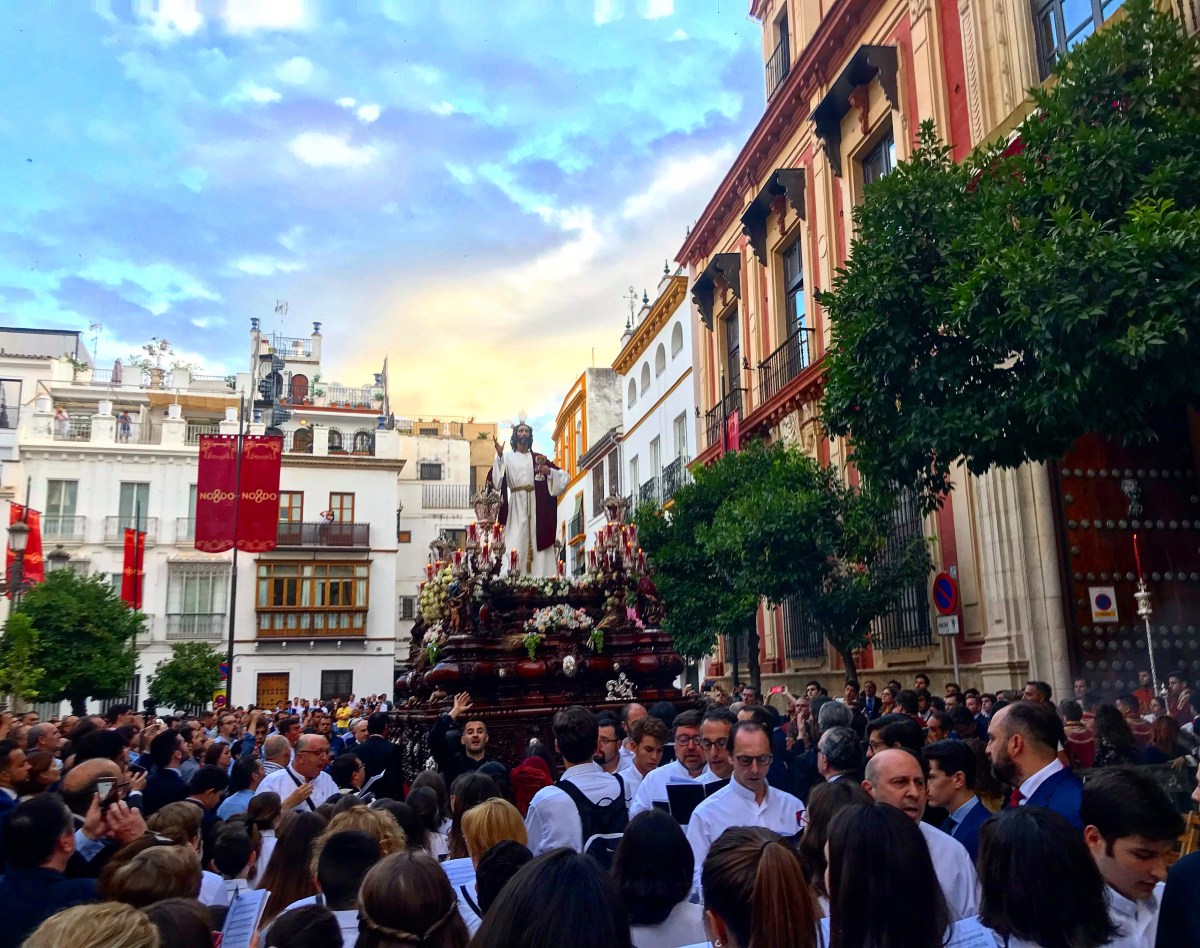
”A city which looks up at the sun, so beautiful for its wealth, nobility and majesty, manners and courtesy; the port of and gateway to the Indies through which it can be said that the whole of Spain sustenance enters twice a year.” Lope de Vega, 1604
DESCRIPTION
Seville is the capital of the province of Andalusia with about 700,000 habitants. It is the fourth largest city in Spain. The history of Sevilla embodies the absolute best (multiculturalism, Mudéjar, flamenco) and the absolute worst (human and cultural persecution of minorities, Transatlantic slave trade, pogrom) of España. These highs and lows make Sevilla one of the most compelling cities for the study of the history of multiculturalism.
HISTORY
Similar to much of España, the earliest archaeological sites of Sevilla are Iberian.
Sevilla, as a city, however, was founded by the Romans. After defeating Carthage for control of the Mediterranean, Romans established the settlements throughout Iberia. Although it is likely a settlement of some type existed previously, Spanish myth says that the city we know as Sevilla today was founded by Julius Caesar. Italica is considered the first Roman city built outside of the Italian peninsula. It is the birthplace of Emperors Trajan and Hadrian.
“And when he (Julius Caesar) reached that place where the city of Talica was first founded, it seemed to him that it was not in a good place, and he went to find another place to rebuild it. 10 And when he came to the place where were to be found the pillars on which Hercules had put the statue, he looked at the great slab of marble which was scattered broken in pieces on the ground. And when he saw the letters, he ordered the pieces to be put together and he read that this was where the great city was to be built. 11 So he ordered it to be moved from where it was and rebuilt there where it is to this day, and he gave it the name Ispalis.” Alfonso X, 1271
Approximately 300 years after its founding as a Roman city, Santa Justa and Rufina were martyred in 287. The sisters refused to renounce their Chrisitian faith and were executed by the Romans. Santa Justa and Rufina are the patron saints of Sevilla and of potters.
After the collapse of the Roman Empire, Visigoths ruled the area. The Visigoths, however, were defeated by the Muslims.
In 711 Sevilla (Isbiliya) became an Islamic city and remained so for 500 years. It is under this Muslim rule that Sevilla was characterized by Convivencia, as Muslim, Christians, and Jews lived side by side. The name of the river that brought Sevilla greatness over its history comes from the arabic al-wādī l-kabīr, Guadalquivir. Sevilla enjoyed great prosperity and ambitious building programs, until 1248, when Spanish Christians under Fernando III, took possession of it. During this time, the local economy fell into ruin.
As Islamic Sevilla fell to the forces of the Reconquista, poet Abu al-Baqa’ al-Rundi wrote beautiful verses about the inevitable collapse of all ideal states:
“Everything declines after reaching perfection, therefore let no man be beguiled by the sweetness of a pleasant life.
As you have observed, these are the decrees that are inconstant: he whom a single moment has made happy, has been harmed by many other moments”
Sevilla played central roles in the Reconquista of Islamic Spain and the Conquista of the Americas. Both historical events see a juxtaposition of a secular objective of land acquisition paired with a spiritual mission of defending and spreading Catholicism. It is in the era of Counter Reformation that Sevilla reaches the pinnacle of its historic relevance.
Soon after the start of the Spanish invasion of the Americas, Sevilla became the gateway to the Spanish Indies. During the Spaniard Conquista, it was the center of the House of Trade, which brought prosperity back into Sevilla as a consequence of the exploitation of the Colonies. All ships leaving to and returning from the Spanish Indies needed to pass through Sevilla. The point of entry was the Torre de Oro, the old Islamic tower on the Guadalquivir River.
Ferdinand Magellan’s voyage to circumnavigate the the globe began its journey from Sevilla in 1519 with a crew of 285. Magellan was killed in the Pacific, but the journey endured. Juan Sebastián de Elcano assumed command of the mission, and reentered Sevilla on 08 September 1522 at the head of the 18 surviving crew members. Before they left and after Elcano completed the journey, the sailors prayed at the Capilla de la Virgen de la Antigua in the Catedral de Sevilla (chapel next to Columbus’ tomb). Carlos V awarded Elcano a crest depicting a globe with the motto Primus circumdedisti me (‘You were the first to circumnavigate me’).
As the Spanish Empire began its decline after the defeat of the Spanish Armada by the English in 1588, so did Sevilla’s prosperity decline.
One of the most compelling and confounding legacies of Sevilla’s role in the Conquista is that out of the genocide of indigenous people and destruction of indigenous cultures rises the concept of universal human rights. Bartolomé de las Casas was a Sevillan writer and theologian that decried his own countries acts of genocide.
“I have seen with my own eyes these gentle, peaceful people subjected to the most inhuman cruelties that have ever been committed by generations of cruel and barbaric men, and for no other reason than insatiable greed, the hunger and thirst for gold on the part of our own people.” Bartolomé de las Casas
This intolerable moral contradiction is best embodied by the fact that Western African slaves were sold on the steps surrounding the Catedral de Sevilla.
As the Spanish empire simultaneously grew and weakened, Sevilla began to lose its role as gateways between Spain and the Americas.
An attempt to revive Sevilla’s greatness occured in 1929, as the city built the Plaza de España. The grand structure featured towers, pools, and tile works representing each region of Spain. Unfortunately for Sevilla, just as it planned its rebirth, the Great Depression devastated global economies. Plaza de España is reputed now for being the location of a scene in Star Wars and for its daily street Flamenco shows.
In 1992, the Universal Exposition world fair opened in Sevilla, which brought the construction of new monuments and the modernization of the city.
SEVILLA LECTURES NOTES
There are three main structures in Sevilla: Real Alcazar, Catedral, and Archivos de los Indies. All three are UNESCO World Heritage Sites. The following is the description of the sites by UNESCO.
https://whc.unesco.org/en/list/383
Together these three buildings form a remarkable monumental complex in the heart of Seville. The cathedral and the Alcázar – dating from the Reconquest of 1248 to the 16th century and imbued with Moorish influences – are an exceptional testimony to the civilization of the Almohads as well as that of Christian Andalusia. The Giralda minaret is the masterpiece of Almohad architecture. It stands next to the cathedral with its five naves; the largest Gothic building in Europe, it houses the tomb of Christopher Columbus. The ancient Lonja, which became the Archivo de Indias, contains valuable documents from the archives of the colonies in the Americas.
Together the Cathedral, Alcázar and Archivo de Indias as a series, form a remarkable monumental complex in the heart of Seville. They perfectly epitomize the Spanish “Golden Age”, incorporating vestiges of Islamic culture, centuries of ecclesiastical power, royal sovereignty and the trading power that Spain acquired through its colonies in the New World.
Founded in 1403 on the site of a former mosque, the Cathedral, built in Gothic and Renaissance style, covers seven centuries of history. With its five naves it is the largest Gothic building in Europe. Its bell tower, the Giralda, was the former minaret of the mosque, a masterpiece of Almohad architecture and now is important example of the cultural syncretism thanks to the top section of the tower, designed in the Renaissance period by Hernán Ruiz. Its “chapter house” is the first known example of the use of the elliptical floor plan in the western world. Ever since its creation, the Cathedral has continued to be used for religious purposes.
The original nucleus of the Alcázar was constructed in the 10th century as the palace of the Moslem governor, and is used even today as the Spanish royal family’s residence in this city, thereby retaining the same purpose for which it was originally intended: as a residence of monarchs and heads of state. Built and rebuilt from the early Middle Ages right up to our times, it consists of a group of palatial buildings and extensive gardens. The Alcázar embraces a rare compendium of cultures where areas of the original Almohad palace – such as the “Patio del Yeso” or the “Jardines del Crucero” – coexist with the Palacio de Pedro I representing Spanish Mudejar art, together with other constructions displaying every cultural style from the Renaissance to the Neoclassical.
The Archivo de Indias building was constructed in 1585 to house the Casa Lonja or Consulado de Mercaderes de Sevilla (Consulate of the merchants of Seville). It became the Archivo General de Indias in 1785, and since then it has become home to the greatest collection of documentation concerning the discovery of and relations with the New World. The Archivo de Indias, designed by the architect responsible for completing El Escorial, Juan de Herrera, is one of the clearest examples of Spanish Renaissance architecture. An enormous influence on Baroque Andalusian architecture and on Spanish neoclassicism, it symbolizes the link between the Old and the New World.
Seville owes its importance during the 16th and 17th centuries to its designation as the capital of the Carrera de Indias (the Indies route: the Spanish trading monopoly with Latin America). It was the “Gateway to the Indies” and the only trading port with the Indies from 1503 until 1718.
The Conjunto Monumental, or group of historic buildings encompassing the Cathedral/Giralda, the Alcázar and the Archivo de Indias, constitutes a remarkable testimony to the major stages of the city’s urban history (Islamic, Christian, and that of Seville with its associations with the New World), as well as symbolizing a city that became the trading capital with the Indies for two centuries – a time during which Seville was the hub of the Spanish monarchy and played a major role in the colonization of Latin America following its discovery by Columbus.
Each one of these monuments is associated with the colonization process. The tomb of Columbus is preserved in the Cathedral. The Sala de los Almirantes (Admirals’ hall) in the Alcázar was the headquarters of the Casa de Contratación (House of Trade), from which the monopoly with the Indies operated, and where, as a seat of learning, it spawned some of the most important expeditions of exploration and discovery of that period. And the Archivo de Indias has, since the 18th century, housed the most valuable and important documents which provide an insight into this historical event.
End of UNESCO description.
CATEDRAL DE SEVILLA

Seville’s cathedral, Santa Maria de la Sede, is the largest Gothic cathedral in the world and is recognized as UNESCO World Heritage.
“Hagamos una Iglesia tan Hermosa y tan grandiosa que Los que la vieren Labrada nos tengan por locos.” (Let us build a church so beautiful and so magnificent that those who see it finished will think we are mad).
THE TOMB OF CHRISTOPHER COLUMBUS
“This is one of the main attractions of the cathedral for visitors, housing the remains of the explorer who died in poverty in Valladolid. The tomb itself is more recent, from 1892, with four bearers presenting the kingdoms of Castile, Leon, Aragon, and Navarra.” https://www.andalucia.com/cities/seville/cathedral.htm#:~:text=The%20tomb%20of%20Christopher%20Columbus,%2C%20Leon%2C%20Aragon%20and%20Navarra.
Other cities claim to hold the remains of Cristobal Colon, as he is known in Spanish – Havana, Cuba, and Santo Domingo in the Dominican Republic – but recent DNA tests proved beyond doubt that this tomb does hold Columbus.
CAPILLA DE LA VIRGEN DE LA ANTIGUA
This chapel with 14th-century frescoes of the Virgin once contained the mihrab of the mosque. The relocated painting of the Virgin is older than the current church.
It is in this chapel that the journey of Magellan and Elcano to circumnavigate the globe began and ended.
GIRALDA

The climb to the top of Giralda is considered well worth the effort for the views alone.
When Islamic artisans began the constructions of this minaret (used for the call to prayer), they utilized recycled Roman blocks as foundation stones. When Catholics then added a Renaissance belltower on top of the minaret, the structure truly contained vestiges of three civilizations: Roman, Islamic, and Catholic.
REAL ALCAZAR DE SEVILLA
Although the Alcazar used to be an Islamic structure, what remains today is primarily a Mudejar. The Courtyard of the Maidens is one of the finest examples of Mudejar architecture in the world.
The original nucleus of the Alcázar was constructed in the 10th century as the palace of the Moslem governor and is used even today as the Spanish royal family’s residence in this city, thereby retaining the same purpose for which it was originally intended: as a residence of monarchs and heads of state. Built and rebuilt from the early Middle Ages right up to our times, it consists of a group of palatial buildings and extensive gardens. The Alcázar embraces a rare compendium of cultures where areas of the original Almohad palace – such as the “Patio del Yeso” or the “Jardines del Crucero” – coexist with the Palacio de Pedro I representing Spanish Mudejar art, together with other constructions displaying every cultural style from the Renaissance to the Neoclassical. (http://whc.unesco.org/en/list/383)
In addition to the Islamic and Mudjar architectural wonders, the Alcazar is home to the 1536 painting The Virgin of the Navigators by Alejo Fernández. This painting is of particular importance because it is thought to be one of the earliest representations by Europeans of the Indigenous people of the Americas.
Learn more about The Virgin of the Navigators on the Khan Academy
https://www.khanacademy.org/humanities/renaissance-reformation/xa6688040:spain-portugal-15th-16th-century/xa6688040:16th-century-spain/a/alejo-fernandez-virgin-of-the-navigators
METROPOL PARASOL

The world’s largest wooden structure is located in Seville, Spain. It is in the city center and the basement floor is a museum for ancient roman artifacts while the ground floors are live Markets.
EDITOR AND LAST UPDATE
John William Bailly 25 April 2022
COPYRIGHT © ALL RIGHTS RESERVED
 Bailly Lectures