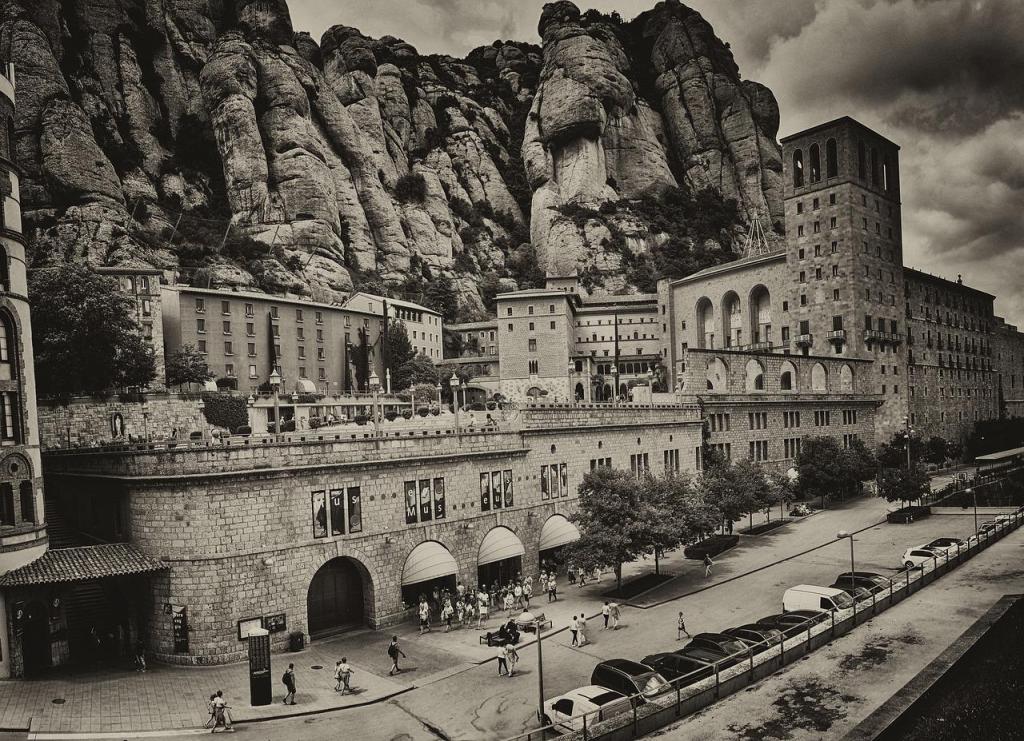
“And we sons of Catalunya will hold our fatherland forever, / as long as the peaks of Montserrat reach to the sky.” Jaume Collell, 1870
DESCRIPTION
Montserrat is a mountain range northwest of Barcelona. Within the mountains is a monastery and surrounding community that is home to the La Moreneta (Black Virgin) Madonna. The landscape and monastery of Montserrat are deeply tied to Catalan identity.
Legend says the mountains were carved by angels with saws.
HISTORY
Montserrat and La Moreneta are so deeply associated with mythology and so rich in history that realty and myth combine into legend. Because of this intertwined story, the mountains of Montserrat are inextricably tied to Catalan identity.
“Legend relates that the miraculous image was first known as La Jerosolimitana (the native of Jerusalem), since it is believed to have been carved in that city during the early days of the church. Another account, seemingly well-attested, indicates that the image was moved to Montserrat in 718, to avoid the danger posed by invading Saracens. The image disappears from the historical record at this point, to reappear in a legend holding that shepherds found the lost statue under supernatural guidance in 890: While tending their flocks that night the shepherds were amazed to see lights and to hear singing coming from the mountain. When this was repeated, the shepherds reported the situation to their priest, who investigated. When the priest also heard the singing and saw the mysterious lights, he informed the Bishop, and he also witnessed the phenomenon. The statue of Our Lady was discovered in a cave and was brought out and placed in a small church that was soon erected.” https://udayton.edu/imri/mary/m/montserrat-black-madonna.php
“The Saracens, unable to beat the counts of Barcelona in war, decided to retreat. Before doing so, they sent an expedition to the mountains of Africa. Its purpose: to catch a young dragon. Moorish hunters snared the little monster, roped it up like a steer, bundled it (not, one presumes, without some fireproofing) into a ship, and sailed it to Catalunya. With fiendish ingenuity they unloaded it at the mouth of the Llobregat, carried it inland, and let it loose. The dragon found itself a lair near Sant Llorenç del Munt, which is still known as the Cova del Drac, the Dragon’s Cave. It adapted nicely to Catalan conditions. At first it satisfied its growing appetite with sheep. Then it took to eating peasants, and then knights, spitting out the armor like pistachio shells. Nobody—not even a Catalan knight named Espes, who had been to Africa and was used to dealing with dragons—could kill the brute. A cavalry squadron attacked it, but the dragon huffed fire and so terrified the horses that they stampeded over the lip of a gorge—a spot still known as the Salt dels Cavalls, or Horses’ Leap. Eventually the Catalans set fire to the forest and smoked it out. It flew to Montserrat but then worked its way back to its cave in Sant Llorenç del Munt. At this point Guifré’s father stepped in. He approached the dragon’s cave on foot, tore off a big oak branch, and went for the reptile hammer and tongs. It showed its Moorish deviousness by grabbing the branch, breaking it in half, and holding the two pieces up in its claws to make the sign of the cross; but undeceived, the hero stabbed the dragon over and over again with his lance and then transfixed it with his sword. The dragon flew up in the air and then crashed, shrieking and flapping, on the far side of the Creu Massif. The Catalans skinned it and stuffed the hide with straw, bringing it out on major feast days like a Chinatown dragon; its gigantic bones—actually, some historians now think, the ribs of a stranded whale—were exposed as relics.” Robert Hughes
It is argued that the Holy Grail from King Arthur and the Knights of the Round Table is located in Montserrat. The Nazis allegedly tried to find it.
Bernat Boïl of Montserrat was part of Columbus’s second voyage to the Western Hemisphere. On 06 January 1494, Boïl conducted the first mass in the Americas in La Isabella (present day Haiti).
BAILLY LECTURE NOTES AND SOURCES
“The image of Our Lady of Montserrat, popularly known as La Moreneta (the Dark One), due to the dark colour of Her skin, is a truly beautiful 12th-century Romanesque polychrome carving. Pope Leo XIII proclaimed Our Lady of Montserrat Patron Saint of Catalonia in 1881. In 1947, the image was enthroned in a silver altarpiece, paid for by popular subscription and installed in the upper section of the basilica apse. Artistically, the image imitates a popular model, that of Our Lady Majesty, with a wholly frontal attitude and Baby Jesus on Her lap in the centre. Both Mother and Child are wearing crowns. The figure of Our Lady stretches out Her right hand, which holds the globe, symbolising the cosmos. Our Lady nearly rests Her left hand on the Child’s shoulder, indicating that this omnipotent king is Her Son. With His right hand, the Child gives a blessing, whilst His left hand holds a pinecone, symbol of fertility and everlasting life.” https://abadiamontserrat.cat/en/our-lady/
MONTSERRAT NATURE PARK
“The geological origins of the massif are sedimentary. The rocks of Montserrat, formed by pebbles bound together by a natural cement of sand and clay, are very hard and resistant to erosion. Nevertheless, the wind and rain have, over time, shaped the mountain to form “needles” or monolithic rocks with strange and varied forms. The popular imagination has seen human or animal shape in some of these peaks, giving them names and inventing legends to explain their fantastic origins.” https://www.montserratvisita.com/en/nature/nature-park
FIU Honors España study abroad makes an annual hike to the peak of the Sant Jeromi.
REFERENCES AND FURTHER READING
Barcelona Turisme. www.barcelonaturisme.com/wv3/en/
Hughes, Robert. Barcelona . Knopf Doubleday Publishing Group. 1992.
Phillips, Jr, William D.; Rahn Phillips, Carla. A Concise History of Spain (Cambridge Concise Histories). Cambridge University Press, 2017.
Steves, Rick. Rick Steves Spain (Travel Guide). Avalon Travel, 2016.
UNESCO World Heritage Foundation. whc.unesco.org/
EDITOR AND LAST UPDATE
John William Bailly 27 June 2023
COPYRIGHT © ALL RIGHTS RESERVED
 Bailly Lectures