
BEAR AND THE MADROÑO TREE
“The first known use of the bear as a symbol of Madrid occurred in 1212 when knights from the city charged into the battle of Las Navas de Tolosa against the Moors carrying standards emblazoned with a bear and the seven stars of the Ursa Minor constellation. But the bear and the strawberry tree as a heraldic emblem was first used a decade later when, in 1222, the image was included as a seal to sign a decree by King Alfonso VIII. This royal decree was written to end a dispute over land rights that had emerged between the church and the city council. The king, in an act of diplomacy, proposed that the trees and woodlands, represented by the strawberry tree (a common species in the region), were to be the property of the city. The animals and the plains, represented by the bear, were to belong to the church. This decree solved the quarrel, and subsequently resulted in the symbol being adopted by the city as its official emblem.” Atlas Obscura
CARLOS III

Historian Stanley Payne wrote that Carlos III “was probably the most successful European ruler of his generation. He had provided firm, consistent, intelligent leadership. He had chosen capable ministers….[his] personal life had won the respect of the people.” Carlos III reduced the influence of the church in government, greatly developed the Palacio Real, built the Prado, opened the Retiro Park to the public, established a school system, and ordered a sewage system for Madrid.
CLOCK TOWER
Clock story. Trains. For years, the clocks had kept the incorrect time. Then three were built…all keeping different times. “If the new clock in the Puerta Del Sol continued to work as it has thus far, it will not displease anyone, since the hours it shows on its three dials are completely different, so that everyone can choose the time that best suits him.” Finally Losada made a proper clock in 1866. Old Post Office. Built at time of Carlos III. Legend has it that the devil appeared to workers, because Carlos III selected a French architect instead of a Spanish one. In Franco’s time, the buliding was used as police headquarters. Today it houses the government of Madrid.
KILOMETER ZERO

Carlos III placed this marker in front of the Post Office of Madrid, as a marker for all distances from the capital.
PLAZA SANTA ANA
No plaza gives a better impression of an authentic square in Madrid than Plaza Santa Ana. This square was home to writers, artists, and intellectuals, as well as bullfighters. It is the quintessential siestas and tapas.
“The word siesta comes from the Latin sexta,” explains Juan José Ortega, vice president of the Spanish Society of Sleep and a somnologist – an expert in sleep medicine. “The Romans stopped to eat and rest at the sixth hour of the day. If we bear in mind that they divided periods of light into 12 hours, then the sixth hour corresponds in Spain to the period between 1pm (in winter) and 3pm (in summer).” http://www.bbc.com/capital/story/20170609-its-time-to-put-the-tired-spanish-siesta-stereotype-to-bed
“As for the term tapa, it apparently dates back to a trip taken by King Alfonso XIII in the early 20th century. The king was travelling to Cadiz with his entourage and stopped to rest and have a drink at a beach tavern called El Ventorrillo del Chato (which still exists today). Alfonzo ordered a glass of sherry, but just as he was about to take a sip, a strong gust of wind swept in a cloud of sand from the beach. The waiter, quick to react, placed a slice of cured ham over the king’s glass. Alfonso, not understanding, asked the waiter what he was doing. The waiter explained that the ham was a “tapa”, which literally means “cover”, so that the wine would not be affected by the sand. The king was amused by the idea, ate the ham and finished off the wine, soon ordering another sherry and asking that he again wanted it with a tapa, just like the first. Soon the king’s entourage also ordered glasses of wine accompanied by those curious “tapas.” and so the term was coined.”
Mark & Peter Besas. Hidden Madrid: A Walking Guide.Madrid. Ediciones La Libreria. 2007.
FEDERICO GARCIA LORCA
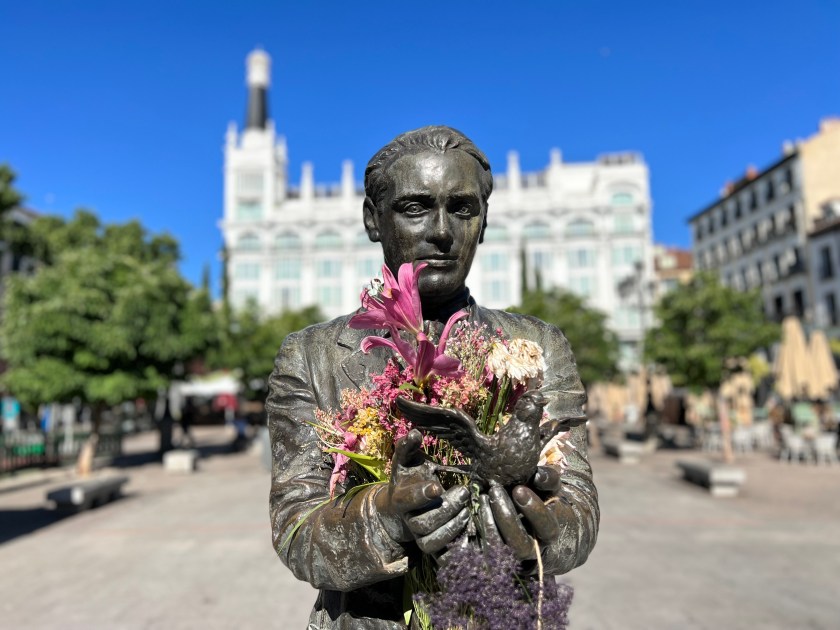
”Born near Granada in Fuente Vaqueros, Spain, to a prosperous farm owner and a pianist, prominent 20th-century Spanish poet and dramatist Federico García Lorca studied law at at the University of Granada before relocating to Madrid in 1919 to focus on his writing. In Madrid he joined a group of avant-garde artists that included Salvador Dali and Luis Buñuel. The group, collectively known as the “Generation of ’27,” introduced Lorca to Surrealism, a movement that would greatly influence his writing. Lorca published numerous volumes of poetry during his career, beginning with Impresiones y paisajes (1918). His lyrical work often incorporates elements of Spanish folklore, Andalusian flamenco and Gypsy culture, and cante jondos, or deep songs, while exploring themes of romantic love and tragedy. With the publication of his poetry collection Romancero Gitano, or Gypsy Ballads (1928), Lorca received significant critical and popular attention, and the following year traveled to New York City, where he found a connection between Spanish deep songs and the African American spirituals he heard in Harlem. When he returned to Spain he co-founded La Barraca, a traveling theater company that performed both Spanish classics and Lorca’s original plays, including the well-known Blood Wedding (1933), in small town squares. Despite the threat of a growing fascist movement in his country, Lorca refused to hide his leftist political views, or his homosexuality, while continuing his ascent as a writer. In August 1936, at the onset of the Spanish Civil War, Lorca was arrested at his country home in Granada by Francisco Franco’s soldiers. He was executed by a firing squad a few days later.” https://www.poetryfoundation.org/poets/federico-garcia-lorca
Sonnet Of The Sweet Complaint
Never let me lose the marvel
of your statue-like eyes, or the accent
the solitary rose of your breath
places on my cheek at night.
I am afraid of being, on this shore,
a branchless trunk, and what I most regret
is having no flower, pulp, or clay
for the worm of my despair.
If you are my hidden treasure,
if you are my cross, my dampened pain,
if I am a dog, and you alone my master,
never let me lose what I have gained,
and adorn the branches of your river
with leaves of my estranged Autumn.
PLAZA MAYOR
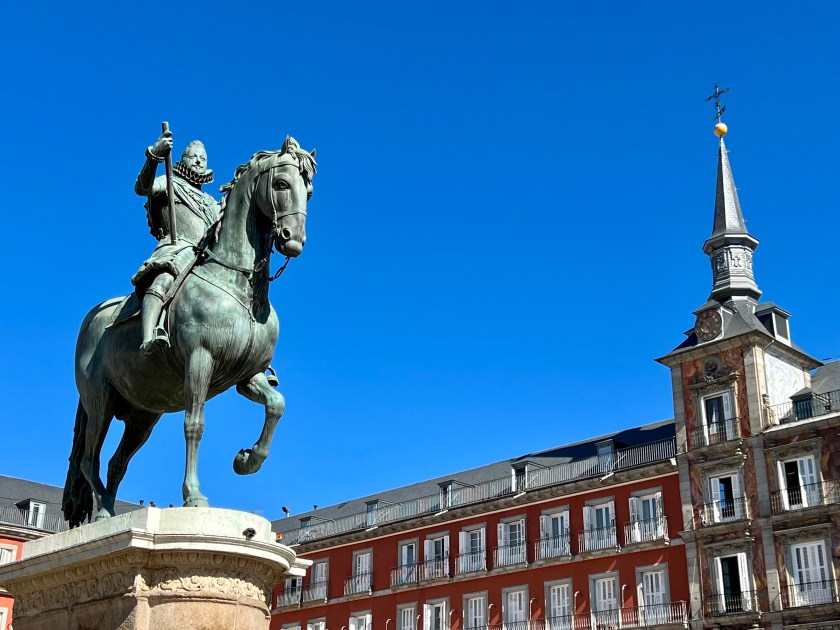
“Before Madrid became the city you see today, filled with large avenues and boulevards, it was made up of small streets and alleys, which today conjure up images of swashbucklers and swindlers. Plaza Mayor was erected on the former Plaza del Arrabal, where Madrid’s most popular market was held till the late 16th century. When King Philip II moved the Spanish court from Toledo to Madrid in 1561, he began to plan a remodelling of the square, although it wasn’t till his son and successor Philip III was in power, that the new square was built. It was designed by architect Juan Gómez de Mora, who brought architectural uniformity to this open space which would be used to host all kinds of events, from local festivities and bullfights to beatifications, coronations and even the occasional auto-da-fé during the Spanish Inquisition. At one end of the square stood -and still stands- Casa de la Panadería. It was erected by Diego Sillero around 1590, although only the cellar and the ground floor of the original building remain. Since it was built, it has served as the town’s main bakery (in charge of setting the price of bread, so even the poorest citizens could afford it), royal chambers, the San Fernando Royal Academy of Fine Arts and the Academy of History. Today it houses the Plaza Mayor Tourist Information Centre and the Tienda Casa de la Panadería, a shop selling souvenirs of Madrid made by local artisans.” https://www.esmadrid.com/en/tourist-information/plaza-mayor-madrid#
FELIPE III
Although the initiative to build Piazza Mayor was under the reign of Felipe II, the plaza was only completed during the time of Felipe III. The monumental equestrian statue pays homage to Felipe III. In 1936, a bomb was placed in the mouth of the statue. When it exploded thousands of bird feathers scattered across the sky, as a result of small birds fatally entering the horse’s mouth of the sculpture for over 300 years.
MERCADO SAN MIGUEL
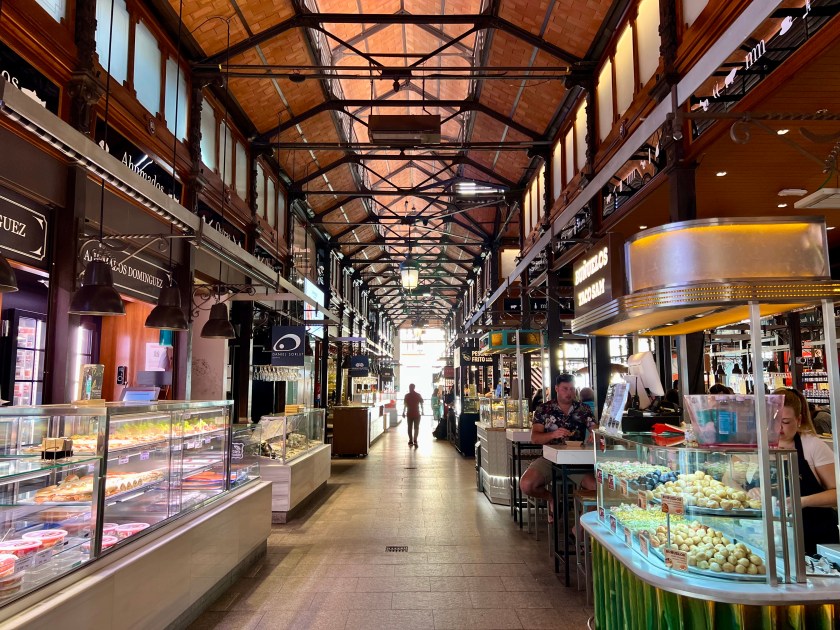
The Mercado San Miguel is an excellent example of cast iron architecture, similar to the Atocha train station and the Eiffel Tower. It was first opened in 1916, and recently reopened as a high end market in 2009. The convivial atmosphere more than compensates for the higher prices.
REFERENCES AND FURTHER READING
“History of Spain.” La Moncloa. https://www.lamoncloa.gob.es/lang/en/espana/historyandculture/history/Paginas/index.aspx
Turismo Madrid: Official Website
https://www.esmadrid.com/en
Besas, Mark & Peter. Hidden Madrid: A Walking Guide.Madrid. Ediciones La Libreria. 2007.
Ham, Anthony; Quintero, Josephine. Lonely Planet Madrid (Travel Guide). Lonely Planet Global Limited, 2021.
Phillips, Jr, William D.; Rahn Phillips, Carla. A Concise History of Spain (Cambridge Concise Histories). Cambridge University Press, 2017.
Shields, Graham. Madrid (World Bibliographical Series). ABC-CLIO, 1996.
Steves, Rick. Rick Steves Spain (Travel Guide). Avalon Travel, 2016.
EDITOR AND LAST UPDATE
John William Bailly 11 June 2023
COPYRIGHT © ALL RIGHTS RESERVED
 Bailly Lectures